


 2 comments
The first house my husband and I owned on the Island was a rambling Victorian on the Tisbury side of Lagoon Pond. It charmed us at first sight with its tall windows, wraparound porch, and double front doors. It lacked just a few things – plumbing, electricity, insulation, and a foundation – so it took ten months before we could move in.
Once we did, in October 1997, there were still decades of cobwebs and dust to be removed. While cleaning one of the bedrooms, I found a crumpled grocery bag stuffed in its closet. I expected to find in it the remains of someone’s forgotten, discarded lunch. Instead, it held a folded-up paper, a yellowed letter, and a stack of glass-plate negative photos showing long-skirted women in horse-drawn carts and men in old-fashioned suits and ties posing in what was now our front yard.

The folded-up paper was a large map of our Vineyard neighborhood, labeled “Oklahoma.” The letter, postmarked 1908, was addressed to an Edward Dossert and concerned the sale of the cottage and waterfront acreage marked on the map.
“We are filled with regret not to return,” the letter read. “We have taken up our concert work again… and have a cottage on the shore, but it is not like the life of freedom at the dear old Innisfail.” It was signed Dellon Dewey. Edward Dossert, I assumed, was a relative of J. Ratcliffe Dossert, from whose estate we’d bought the cottage. But who was Dellon Dewey? And what was “dear old Innisfail”?
Eulalie Regan – the former librarian for the Vineyard Gazette, and the mother of the architect overseeing our renovation – soon provided an answer.

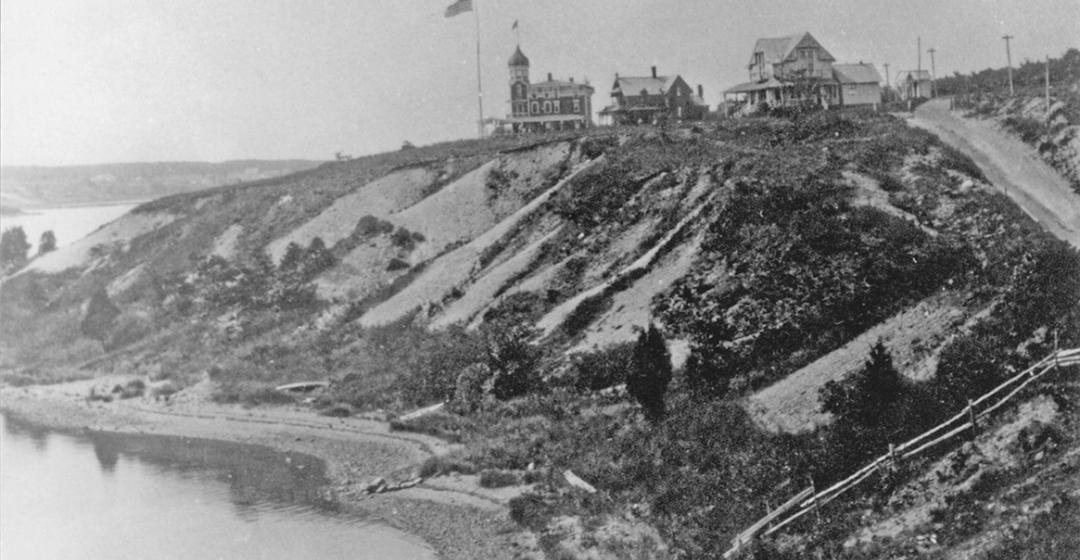
Innisfail, as explained in a July 1940 Gazette editorial provided by Regan, was a grand hotel built in 1876 that once stood on the banks of the Lagoon, yards from my new home. It was formally acquired in 1897 by Dellon M. Dewey Jr., a native of Rochester, New York, and his long-time companion, Tom Karl, a tenor well-known throughout the U.S. and Europe.
Dewey and Karl envisioned the hotel not as a summer resort for vacationers but as “an ideal home for singers and artists,” one that would provide “first class concerts by professional singers…at both Cottage City [Oak Bluffs] and Vineyard Haven.” For a while, their vision came to pass. During its heyday, Innisfail was the center of a thriving music and entertainment scene – one that drew talented musicians and revelers from all over the world. The comings and goings were reported in newspapers on the Island and off.
“Innisfail, that nest of singing birds, is running over; more than a hundred guests at last report,” read an August 19, 1897, article in the Martha’s Vineyard Herald. Then, in 1906, the hotel burned to the ground, bringing a sudden end to the festivities.

“One by one the men and women who knew Innisfail have passed on, and the golden age of that Vineyard hotel falls even further into the background of dimly remembered history,” read the 1940 editorial in the Gazette.
I published what I learned about the vibrant seaside music community in a 2001 edition of the journal of the Martha’s Vineyard Historical Society. Although questions remained, I’d exhausted my research sources and moved on to other projects. My husband and I also moved into another house, across town.
In 2024, with the support of the Martha’s Vineyard Museum, I relaunched my treasure hunt for information, one that eventually yielded dozens of never-before-seen artifacts from private and public collections on the Vineyard and in Maine, Boston, New York, and Portsmouth, New Hampshire. These are now on display in an exhibit titled “The Lost History of Innisfail” at the Martha’s Vineyard Museum.

***
To understand the history of Innisfail, it is necessary to understand what came before it. It is a story of what was and what might have been.
Like all of the land on Martha’s Vineyard, the area along the banks of the Lagoon was originally inhabited by the Wampanoag people. By 1872, the area between the Tisbury shore of the Lagoon and Edgartown–Vineyard Haven Road caught the attention of developers. Dukes County sheriff Howes Norris and Edward Ingraham, a famed clockmaker from Bristol, Connecticut, envisioned an expansive subdivision.

They named it Oklahoma and divided it into 664 lots, almost all just fifty feet wide. The developers hoped to sell the lots and build a summer cottage on each, similar to Wesleyan Grove in Oak Bluffs. The center of the planned subdivision was Oklahoma Hall, a grand hotel with a five-story tower and a covered veranda on the front and sides set on a bluff high above the Lagoon.
The name Oklahoma was perhaps chosen because using such Native American names was trendy and appealing to the wealthy crowd they were trying to attract. (Other examples include Mohawk Street and Iroquois Avenue, both on West Chop.) Ingraham encouraged residents of Bristol, Connecticut, to buy lots and build cottages in the subdivision. Sheriff Norris – who was also editor and publisher of the Cottage City Star – referred to them in that newspaper as “the Connecticut Colony.”
Although Ingraham’s role in the Oklahoma project faded fast, he brought Wallace Barnes, a prosperous clock-spring manufacturer, into the project. Barnes oversaw construction of the hotel. He also applied to the town to build a road between Vineyard Haven and the resort. When that effort failed, he rented a forty-foot steam launch to make trips up the Lagoon and began building roads himself. A portion, present-day Barnes Road, still bears his name, running from Oak Bluffs to the head of the Lagoon.
Oklahoma Hall and the development fell on hard times. Less than a dozen planned cottages were ever built. Barnes attempted to pivot and start a summer music school with his daughter’s music teacher, Caroline Rockwood, but that lasted just two summers.

A New York vocal instructor, Frederick Bristol, next attempted to revive the hotel as a summer music colony. He renamed the hotel Villa Bristhall and created, according to the Herald, “an abode of Bohemian harmony combined with the most cultivated artistic instinct.” One of Bristol’s guests – comic opera star Henry Clay Barnabee – may have provided the link between the Villa Bristhall and Innisfail eras: Barnabee sang baritone in the wildly popular Boston Ideal Opera Company; Karl was lead tenor.
***
Although it seems remarkable that someone once so famous is today so forgotten, Karl was a major celebrity in his time. Born Thomas Carroll in Dublin, Ireland, he left home at nineteen to study opera and debuted at the famed La Scala opera house in Milan.

Karl came to the United States in 1872 as one of several tenors in a British grand opera troupe conducting an American tour. He quickly built a reputation as a handsome and talented musician. In 1879, the newly formed Boston Ideal Opera Company made him lead tenor. The new troupe’s massive success with a repertoire centered on popular Gilbert and Sullivan operettas transformed Karl from a popular singer to a national sensation; for decades, critics referred to him as “America’s tenor.”
In the mid-1890s, Karl stepped away from the troupe he founded, The Bostonians, and he and Dewey purchased and expanded a cottage in Frederick Bristol’s arts colony on the Island. They named their cottage Linda Vista. Karl, Dewey, and Bristol ran the Villa Bristhall arts colony together for a year. In 1897, Bristol sold his share to Karl and Dewey, who renamed the hotel Innisfail.
As proprietors of Innisfail, Karl and Dewey attracted wide attention for their parties and the celebrities who came both because of Karl’s fame and Dewey’s family’s social standing. (Dewey was related to national war hero Admiral George Dewey.) The father of a very young Katharine Cornell brought the future Broadway star to the hotel. Later in life, the famous actress credited her stays there, and hearing Karl sing, with her desire to return to and purchase property on the Vineyard.

Innisfail was “constantly en fete,” according to Henry Beetle Hough’s book, Martha’s Vineyard: Summer Resort, 1835-1935, and “each new arrival was the occasion for a party or a celebration.” A photo from that time shows a gathering of friends around a table inside one of the cottages with beer steins raised. It was a remarkable sight, given that the temperance movement was in full force in the dry town of Tisbury.
National publications reported on events at the hotel. In August 1899 the Boston Globe covered a “birthnight ball at Innisfail” to celebrate Dewey’s birthday: The hotel was decorated inside and out; entertainment included a concert by Karl and others in the hotel music room, followed by a performance by the Cottage City band and a dance. Supper was served near midnight on the veranda overlooking the Lagoon.
Karl and his friends entertained one another but also the Island as a whole. An 1899 edition of The Musical Courier, a national journal, reported on such events, including a private gathering at the Governor Ames mansion in Cottage City, where Karl sang after dinner, and a public concert of Innisfail artists that filled Union Chapel despite an admission fee of one dollar.

***
Though Innisfail caused quite a stir, it ultimately failed to turn a profit. Throughout its history, the hotel’s owners struggled to stay in the black. The difficulty of transporting guests from town to the hotel, always an issue, likely tamped down the number of visitors.
Karl and Dewey probably worsened the situation by turning the hotel into a private club: guests were supposed to pay, but first they had to be invited. Filling Innisfail with friends may have added to the convivial spirit, but Karl’s lavish spending on friends was well-documented. It’s easy to imagine him being reluctant to present a bill to his friends at the end of their stay.

The pair borrowed money for Innisfail on at least one occasion: the Martha’s Vineyard Museum exhibit contains a 1901 promissory note from Karl and Dewey for $3,000 (about $115,000 in today’s money). In 1903, in an effort to right the inn’s finances, they turned management over to Charles Norton, a local businessman.
In the end, none of that mattered. The Innisfail era came to an abrupt close in May of 1906, when a multi-day brush fire broke out. On May 13, the fire reached and destroyed the hotel. The front page of the Boston Post carried the story the next day. “The well-known summer hotel at Oklahoma, known as the Innesfield [sic], situated on the shores of Lagoon pond, dry as a bone as to its roof, caught from the flying, blazing branches and … was burned with its contents, to the ground.”
Norton sent a postcard with Innisfail’s image that same day to Henry Clay Barnabee: “Hotel burned.”

Four cottages survived the blaze. One soon fell into disrepair and collapsed. The others, occupied only during a few summer weeks, were boarded up most of the year. One of them – Karl and Dewey’s “Linda Vista” - became mine.
Following the fire, Dewey and Karl made their way to California; it’s from there that Dewey sent the letter I found in my new home. Karl tried to launch The Californians, a new opera troupe, but it lasted only a season. Next, they moved to Manhattan, where Karl kept a studio at Carnegie Hall and gave voice lessons for several years before moving to Dewey’s hometown, Rochester, where the pair shared a stately home.
If their relationship was romantic, Karl and Dewey weren’t public about it, but that would have been expected at the time. In the late 1890s, when they were establishing the Innisfail resort, Oscar Wilde was on trial for homosexuality. Karl was also a devout Catholic and counted senior clergy, including bishops, among his friends.

Whatever the nature of their relationship, Dewey and Karl remained loyal to one another until the end. When Karl collapsed and died in 1916, his obituaries repeatedly noted Dewey’s role as “devoted companion.” Dewey, though nearly five years younger and in good health, soon faded. His obituary said, “A year ago Tom Karl died and since that time Mr. Dewey’s health failed. He made brief visits to friends in other cities but seemed unable to regain his strength or interest in life.”
The Oklahoma neighborhood also fell silent. Vineyard locals dubbed the once-vibrant neighborhood “Ghost Town.” Some individuals occasionally poked around the hotel ruins; a few explored the unoccupied cottages as well.
Historian and teacher Chris Baer – who played a major role in documenting the pre-Innisfail history for the exhibit – donated items for display. They include a wooden sailor figure and a book gifted to Tom Karl from the prima donna Emma Abbott, mementos his parents Gene and Jacqueline Baer “collected” from the Karl-Dewey cottage when they were courting and liked to explore the area.
The Ghost Town era lasted until the early 1990s. Gradually, as land values rose, people bought up the lots and restored the cottages. Memories of Innisfail all but disappeared. For my former neighbor Victor Capoccia, however, the history of Innisfail has been a continual source of fascination since he built there in the late 1990s. In 2023, he asked Anna Barber, the museum’s curator of exhibits, if she might be interested in an exhibit about the neighborhood and suggested I could help with research.

At the time, other projects had my attention. But I attended a neighborhood meeting that he organized and shared what I knew about Innisfail with Barber. That conversation relit my desire to continue the hunt for my old neighborhood’s story.
The digitization of archives since I published the 2001 article in the historical society’s journal changed everything. Searching online quickly led me to archives and collections up and down the East Coast. Thanks to those, and the diligent work of many people, we were able to gather a trove of photos, playbills, documents, and recordings to display at the museum that shed light on the vibrant scene that once unfolded on the banks of the Lagoon.
When the exhibit opened in October, a robust crowd packed the gallery and spilled into the hall, just a short distance from the former site of the stately hotel. Witnessing so many others drawn to the magic of this all-but-forgotten moment in Island history overwhelmed me. People recounted their memories of the neighborhood; a couple who knew J. Ratcliffe Dossert, the “last of the Innisfailers,” promised to share at a later date the stories he’d told them. That evening brought rushing back the memory from 1997 when, weary from cleaning up cobwebs and dust, I found that crumpled brown paper sack. And that moment when I considered tossing it in the trash but decided instead to look inside.
“The Lost History of Innisfail” exhibit runs until January 11, 2026, at the Martha’s Vineyard Museum. For more information, go to mvmuseum.org.

Comments (2)