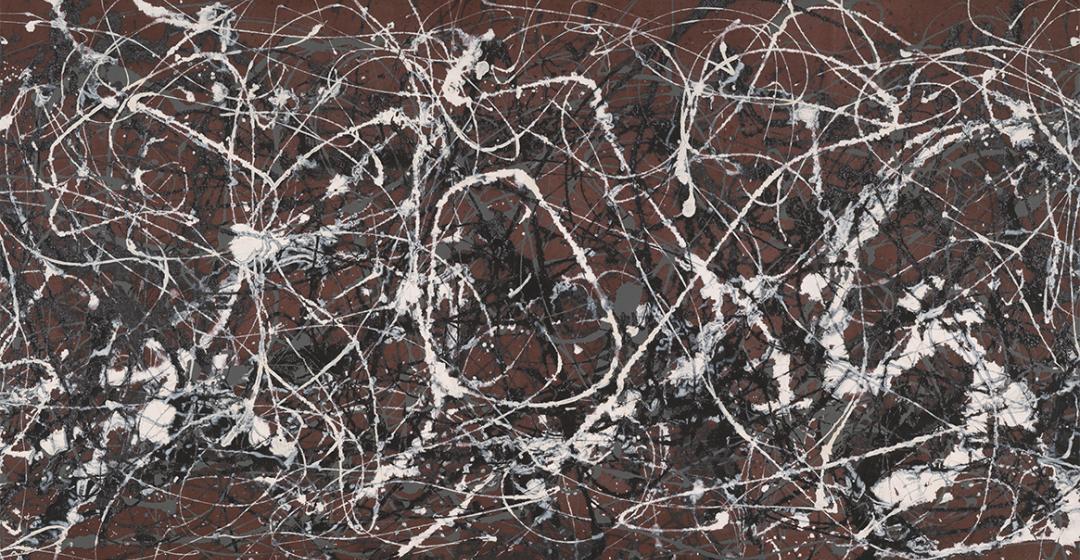


To most people, Jackson Pollock and Martha’s Vineyard don’t seem to have much in common. But, in fact, the seven summers that the notorious drip painter spent on the Vineyard – from 1931 to 1937 – left a lasting influence on his life and work.
Why is this connection not more widely known? A good part of the reason is that it’s still a bit of an artistic taboo to mention Pollock’s relationship with Thomas Hart Benton, the acclaimed artist and seasonal Island resident who brought Pollock to the Vineyard. Benton today is best remembered as the leader of the Regionalist movement, which centered around “realistic” scenes of the American Midwest. Pollock is more closely associated with the New York School, which produced paintings that are generally viewed as pure abstractions – although most, if not all, of his paintings seem to have figurative elements.

To discuss their relationship quickly leads to overturning most of the clichés and stereotypes that are usually attached to both figures and turning a good many of our notions about twentieth-century American art upside down and inside out. It’s still a bit scandalous to point out, for instance, that Benton was Pollock’s only artistic teacher, and that their relationship was not brief. In fact, Pollock kept it up for twenty-six years, often through drunken late-night phone calls, right up to the time of his death in 1956.
The two first met in 1930 when Pollock – who never graduated from high school – decided to join his older brother, Charles, to study with Benton at the Art Students League of New York. At the time, Benton was chiefly known for modernist paintings, inspired by art he had encountered during his student years in Paris, where he absorbed a great variety of modern styles from Impressionism to Synchromism. Beginning in 1926, he also published a groundbreaking five-part essay in Arts magazine, “The Mechanics of Form Organization in Painting,” which explored the principles of abstract composition and would later influence Pollock.
But as it happened, when Pollock arrived, Benton was hard at work on what was to prove his breakthrough painting: the mural America Today, now in the Metropolitan Museum of Art in New York. Based on sketches Benton had made while traveling across the United States, this was the first great American mural to feature working-class subject matter, and it provided much of the impetus for a government-sponsored mural program of the 1930s that had the goal of providing economic relief to artists, enriching communities, and making public art more accessible.
Pollock helped with the physical labor that went into America Today, preparing and moving around the heavy panels on which the mural was executed. He also posed for the painting – as it were, experiencing what it was like to live inside a painting by Benton. Pollock went on to become one of Benton’s most loyal and devoted students.

During this period, Pollock also became a fixture in Benton’s New York home. He and his brother lived in an apartment downstairs from Benton and his wife Rita. They were desperately poor – so poor that they often couldn’t afford food. To help them out, Rita regularly invited them upstairs for meals, and took a particularly motherly interest in Jackson, who was the youngest. She enlisted him to help with small chores and paid him for babysitting her son, Thomas Piacenza Benton (always known as T. P.). She also taught him her spaghetti recipe, which he still remembered and practiced decades later.
While Pollock is generally pictured today as a violent, destructive drunk, during these early years he stood out as exceptionally gentle, kind, and considerate – although also inarticulate and withdrawn. When I once asked T. P. how he would describe Pollock, the word he settled on was “nice.” “The nicest person I’ve ever known.”
Starting in 1931, and continuing for the next six years, Pollock made several sketching trips through the West, modeled on ones Benton had taken. He generally traveled in the company of other Benton students, such as Whitney Darrow and Glen Rounds. Much of those summers, however, were spent with Benton and his family at his Chilmark home, which he purchased in 1928.

When Benton acquired the home, it was essentially a small shack with an attached chicken coop and a small barn for cows. With the help of a local carpenter, he began renovating the accommodations made for animals to serve the needs of humans. Even today the property has awkward features that reflect the difficulties of this challenge – it’s still an assortment of oddly configured little boxes, and you often need to duck your head as you move from one room to another.
By the time Pollock arrived, most of the carpentry on the home was complete, but there was lots of painting that needed to be done. Pollock undertook chores, such as house painting and babysitting T. P., in exchange for room and board. He also made paintings and decorative ceramics and would spend much of the time just soaking up the sun, sand, and sea.
To provide Pollock with a space of his own as a studio and as a place to sleep, he and Benton, using driftwood they collected, fixed up a former chicken coop behind the house that became known as “Jack’s Shack.” This was still standing when I first visited his daughter, Jessie Benton, on the Vineyard in the summer of 1986, but has since rotted away. The best surviving record of it seems to be a watercolor made by one of Jessie’s associates, Eben Given.

In his final years, Pollock often looked back to this period as the happiest time in his life. As Benton recalled in a 1958 essay about his friend:
“At frequent intervals, and up to within a few months of his death, he would make long-distance phone calls and would talk about his early days with us, mostly about those spent on Martha’s Vineyard. Often on these occasions he would be pretty well tanked up, but that only made him more affectionate. As for Martha’s Vineyard, it is quite probable that the only really happy times of his life were had there, taking his end of a two-handled tree saw, swimming in the surf, gathering clams for chowder or wild berries for pies.”
By objective standards, Pollock was one of the least talented of Benton’s pupils – he was inarticulate, his drawings were clumsy, and he couldn’t play an instrument, the usual ticket into Benton’s inner circle. But curiously, he established a longer and closer relationship with Benton than any other student over the full course of Benton’s career, and in the end, he was the Benton student who achieved the greatest national fame. For Pollock, Benton became a father figure – a substitute for the weak and absent father nature had given him, while Rita became his “ideal woman.”

•••
The artwork Pollock produced on Martha’s Vineyard can be broadly divided into two types. The first consists of paintings, generally rather small, that closely relate to the paintings and drawings that Benton was making at this time. In some instances, they are even direct copies.
During this period, Benton created illustrations for We, the People (Monthly Review Press, 1964), a Marxist history of the United States by his friend Leo Huberman. Several of Pollock’s paintings closely echo these designs. Going West, for example, is essentially a variation on Benton’s illustration of westward migration for the book.
Although Pollock was not very skilled in making realistic figure drawings, he captured very nicely the sweeping rhythmic quality of Benton’s compositions, which he in turn had absorbed in good part from the work of the nineteenth-century mystical painter Albert Pinkham Ryder. In the 1920s, Benton made a number of moonlit seascapes inspired by Ryder, and the dark colors and moody qualities of many of Pollock’s paintings clearly owe a debt to Ryder as well. Years later, when he had achieved fame as an abstract painter, Pollock would declare that “Ryder is the only American painter who interests me.”

Despite Pollock’s struggles with accurate drawing, Benton and Rita were appreciative of his early efforts and purchased a number of them. Later in life, Benton wrote of Pollock’s early paintings of this sort:
“I have no doubt that his contributions to Regionalism, had he continued to make them, would have been quite as original as the purely formalistic exercises to which he later devoted himself. They would also have had some added values.... His Western boyhood had given him a penchant for all the spooky mythologies of the West with its vision of wild stallions, shadowy white wolves, lost gold mines and mysterious untended campfires... Judging from his early efforts he would have injected a mystic strain into the more generally prosaic characteristics of Regionalism.”

Alongside these Benton-inspired works, Pollock also painted original designs of his own, based on the landscape of Menemsha Pond. About half a mile across, it made the perfect place for a small boy learning to sail. Many of Pollock’s paintings of the Vineyard show T. P.’s little dinghy sailing on this stretch of water. I had the luxury of hanging Menemsha Pond, one of Pollock’s paintings of this subject, in my office back in the time when I was a curator at the Nelson-Atkins Museum of Art in Kansas City, Missouri. Because it was so small, the curator of contemporary art, Deborah Emont Scott, had no interest in putting it on public view.
Pollock’s best painting of this subject is probably T. P.’s Boat in Menemsha Pond, which was donated by Benton to the New Britain Museum of American Art in Connecticut. What’s fascinating is how land, sandbar, pond, ocean, sailboats, clouds, turbulent sky, and setting sun have been simplified into amoeba-like shapes and reconfigured into a rhythmic design. It’s a haunting, emotional synthesis rather than a literal scene.
Another important influence came through ceramics. During the 1920s Benton made decorative ceramics that are often surprisingly abstract in their approach. One example is an abstract tile he created in 1922. If you made four copies of this tile, and turned each of them a different way, you would have a composition surprisingly similar to that of Pollock’s mature abstract paintings.

Under Benton’s guidance, and often in partnership with Rita, Pollock made a number of ceramic designs of this sort, some of which Benton and Rita purchased. One example is a footed bowl, enamel on Limoges porcelain, which Rita later donated to the Nelson-Atkins Museum of Art.
Notably, it was during this period that Pollock absorbed Benton’s theories of pictorial rhythm, developed in “The Mechanics of Form Organization in Painting.” Beneath the apparent spontaneity of the drip paintings lies an underlying rhythmic order that owes much to Benton’s teaching.
•••
Pollock continued his relationship with the Bentons through late-night phone calls up to the end of his life, but two factors ruptured their in-person contact. One was that in 1935 Benton was offered a teaching position at the Kansas City Art Institute and a commission to paint a large mural for the Missouri State Capitol. These positions provided a financial security he had not enjoyed. With blustering fanfare, he departed from New York. Thus, Pollock lost daily contact with the parental figures he had depended on for support.
The other factor is that Pollock descended into alcoholism. While Benton was a heavy drinker, Pollock does not seem to have imbibed alcohol to any great extent when he was staying with the Bentons. The one episode of that sort they witnessed occurred in 1937, when Pollock took the ferry to Martha’s Vineyard and, after arriving, had difficulty reaching the Bentons, who did not have a phone. It took several hours for his message to arrive. By the time it did, Pollock had consumed the better part of a bottle of gin, had created a disturbance by chasing girls on his bicycle, and had been arrested for drunken misbehavior. Benton picked him up at the jail in Edgartown, where he paid a fine for disorderly conduct to the local sheriff to get Pollock released.

Interestingly, that seems to have been Pollock’s only drunken escapade that summer, although after the Bentons left New York for Kansas City later that year, he fell into a pattern of drinking himself into unconsciousness.
The remainder of Pollock’s life was a continuous struggle with alcoholism. What’s clear in retrospect is that he also suffered from bipolar illness – also known as manic-depression, which is now treatable, with varied degrees of success, through medication but was then incurable. Alcoholism and bipolar illness are often linked, and to some extent alcohol seems to serve as a “medication” for bipolar illness, although one with side-effects that are also deadly.
While generally overlooked by scholars, and while much of his work here was artistically modest, it’s clear that in many ways Pollock’s years on the Vineyard provided a foundation for his later, more famous abstract work. It was here, from Benton, that he absorbed the principles of design and rhythmic organization that he used to compose his famous drip paintings. It was also here that he developed his moody color palette.

It’s possible that his sojourn had an even more momentous impact. Where did Pollock learn to drip? So far, the earliest known drip painting by him dates from 1944. Could he have made one earlier?
An old New England tradition, going back to colonial times, is to splatter-paint a floor. Rita seems to have learned this technique from a local carpenter and jack-of-all-trades, Roger Allen, a descendant of one of the early settlers on Martha’s Vineyard who often worked alongside Benton doing carpentry on the home. This technique produces a pleasing decorative effect and helps hide dirt. It takes a bit of experimentation to learn to do this well. Essentially, you dip the end of a brush into very liquid house paint and then bang the handle of the brush hard against the back of your hand. Initially, this typically results in big dribbles on the floor, but with some practice one can learn to make a pleasing scatter pattern of little drops, and to develop some degree of control over how they fall.
At some point in the 1930s, probably around the time that Benton stayed on the Vineyard, this technique was employed on the floor of the Benton’s bedroom. I suspect that Rita was involved, since the colors employed are those of the flag of her homeland, Italy – red and green. But it also seems quite possible that Pollock helped her do the splattering.
And even if he didn’t, it seems likely that while staying on the Vineyard, he witnessed this technique, which he would later employ on his famous series of dripped, splattered, and poured abstractions, which transformed the history of American art. Great art often seems to be produced by taking “low-class” art forms or crafts, which are not regarded as of major significance, and drawing from them to create major forms of artistic expression of a sort untried before. Perhaps Pollock’s famous drip paintings are an instance of this – splatter-painted floors transformed into great art.
A graduate of Harvard University, Henry Adams received his master’s and Ph.D. in art history from Yale University, where he received the Frances Blanshard Prize for the best doctoral dissertation in art history. He is the author of just under 500 publications on art historical topics, as well as nearly thirty books, mostly in the American field. His book titles include Thomas Hart Benton: An American Original (Knopf, 1989) and Tom and Jack: The Intertwined Lives of Thomas Hart Benton and Jackson Pollock (Bloomsbury Press, 2009). In 1989 he curated a Centennial Exhibition of Benton’s work for the Nelson-Atkins Museum of Art and also worked with Ken Burns on the film Thomas Hart Benton, which accompanied the show. The film brought him to Martha’s Vineyard several times to meet with Benton’s daughter, the late Jessie Benton, who became a friend.