

Thirty-nine years ago, Massachusetts Division of Fisheries and Wildlife (DFW) officials met with about a hundred Islanders at the Grange Hall in West Tisbury to discuss an increase in Martha’s Vineyard’s hunting season bag limit from one to two deer. The rule change was the best way to manage the worrisome growth of the Island’s deer herd, they said.
In a tense discussion, Island proponents highlighted crop damage, unchecked herd growth, and vehicular collisions, according to a June 1987 Vineyard Gazette report. Opponents were concerned about the safety risks increased hunting posed to the general public and whether all alternatives had been explored. There was no mention of ticks.
DFW raised the limit beginning with the 1988 hunting season. Speaking to the Vineyard Gazette about the decision, wildlife biologist Dr. Steve A. Williams issued a prophetic warning about Island property owners who prohibited hunting. “This restriction contributes to increased density of deer,” Williams said. “They must think through the consequences of their actions.”

Four decades later, marking a sea change in public sentiment where landowners once posted “no hunting” signs, deer hunters are now being invited to shoot deer from back porches – the bumbling cartoon hunter Elmer Fudd now has the stature of Natty Bumppo.
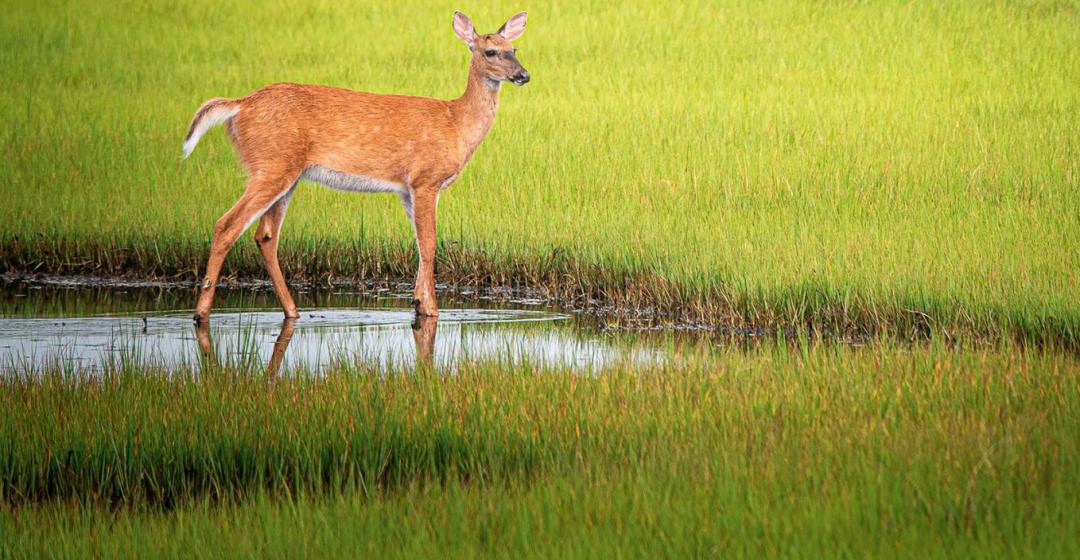
This shift comes as DFW officials, Island public health leaders, and Tick Free Martha’s Vineyard (Tick Free MV) – a newly formed, well-funded, and energetic nonprofit – are actively enlisting hunters to play a vital role in an emerging public health war on ticks. Their goal is to significantly reduce the Island’s large white-tailed deer herd, identified as an important link in the tick life cycle.
The Vineyard is home to the deer tick, wood tick (also known as the dog tick), and a relatively new nuisance: the lone star tick. Together, they can transmit Lyme disease, anaplasmosis, ehrlichiosis, babesiosis, Rocky Mountain spotted fever, tularemia, and the rare but untreatable Powassan virus.

For some people, but not all, a mere bite from the lone star tick may trigger the much-publicized alpha-gal syndrome (AGS), a not fully understood, mild-to-severe allergic reaction to red meat and mammalian-derived products.
For years, dog and deer ticks were pretty much an unwelcome but accepted part of Island life. Lyme disease was the dominant concern but had little effect on the Island’s popularity as a vacation destination or on outdoor activities. That changed with the recent explosion of lone star ticks, which coincided with a sharp increase in alpha-gal-related cases recorded at Martha’s Vineyard Hospital: two in 2020 to 742 in 2025.
Some Islanders are no longer willing to accept that risk. Last winter, Tick Free MV paid White Buffalo – a Connecticut-based nonprofit – to conduct a thermal-imaging drone survey of the deer population on the Island. A lingering snow cover provided ideal conditions. The final count was 4,681 deer.

That number must be viewed in the context of the extended 2025–2026 hunting season, which included a late-winter hunt in January and February and preceded the survey. In total, hunters harvested 935 deer. The spring fawning season likely replenished that loss.
Based on those numbers, Tick Free MV executive director Virginia Barbatti said the nonprofit’s goal is to reduce the deer herd by 70 percent, from more than 5,000 animals to 1,500 or less. In support of that effort, last season they provided a cash bounty of $100 per buck and $150 per doe for each animal checked in to the Agricultural Society Community Deer Cooler or the Martha’s Vineyard Hunt Club cooler and donated to the Hunters Share the Harvest program. The latter program provides packaged venison to food pantries across the state.
During that same period, the nonprofit paid hunters a total of $12,300, according to Dukes County tick biologist Patrick Roden-Reynolds, who managed the harvest donation program. Members of the hunt club – which manages hunting on various properties and is one of two DFW-approved Island processors – accounted for the majority of the deer donated and processed last season, with more than 6,000 venison meals.

State deer and moose project leader Martin Feehan, Ph.D., puts estimated Island deer density at more than fifty-five animals per square mile where hunting is allowed, and higher on closed properties – second only to Nantucket in the state. Ideally, he would like it reduced to twelve to eighteen per square mile.
DFW’s strategy for reducing the herd is to expand hunting opportunities by increasing seasons and bag limits, encouraging landowners to open more properties, supporting local processing, and pressing for regulatory changes to increase hunter participation.
Additionally, the agency is encouraging Island land trusts, farms, and qualified individual property owners to apply for a deer damage permit (DDP), which allows the permit holder or an authorized designee to remove deer outside hunting season in accordance with a DFW-approved plan. Recreational season restrictions do not apply. For example, deer may be baited and shot at night using crossbows or firearms. The DDP allows the permit holder to keep two deer for consumption; beyond that, deer must be donated to the state harvest program.

DFW’s long-standing position is that recreational hunting seasons remain the best deer management tool. Calls for alternatives, such as sterilization and professional “lethal removal,” fail to take into account their limited effectiveness, except in small, closed communities and the enormous costs of maintaining those programs, Feehan said.
White Buffalo, which specializes in “population control of white-tailed deer” in suburban and urban settings, charges $1,000 to $2,000 per animal for sterilization and $400 to $800 per deer for sharpshooting. Processing is an additional $70 to $125 per deer.
Tick biology is a numbers game. A deer tick lays approximately 2,000 to 3,000 eggs. The more fecund lone star lays a cluster of 3,000 to 8,000 eggs, which gives rise to the notorious tick bomb when hundreds of tiny nymphs cluster together in search of a blood meal (for instance, an ankle).
Roden-Reynolds said ticks feed on different animals at different life stages, “but the bottleneck is what the adult ticks bite in order to mate and reproduce.” He found a vivid example on the ear of a buck removed from a farm property in June under a DDP permit. Roden-Reynolds counted at least 150 adult lone star ticks on the right ear alone, “and that did not include what was attached to the antlers and velvet, the left ear, and the butt end of the deer,” he said.

Deer provide the optimal feeding and breeding platform. After mating, the male will drop off the deer, but the female will continue to feed until she’s fully engorged on a blood meal. She will then drop off her deer host as it travels – through a field, a woodland, or an Island backyard.
•••
In 1988, when the Island bag limit was increased to two deer, Wildlife Management Zone 13 (which comprises the Vineyard and Elizabeth Islands) offered a three-week archery season, a one-week shotgun season, and a three-day muzzleloader season, for a total of twenty-seven hunting days. The season tally was 192 deer.
The upcoming 2026–2027 fall–winter deer hunting season for Zones 13 and 14 (Nantucket) will run six months, from mid-September to mid-February. The season begins with a special two-week muzzleloader season.

Island social media discussions generate no shortage of proposed alternatives to hunting, most of which are not based on science. Flocks of noisy guinea hens? Studies show they prefer a juicy grub or worm to a scrawny tick. Opossums? Ticks are not their preferred diet.
“We need coyotes” is a common refrain. Not so fast. By the time the coyotes get done eating all of the Island’s turkeys, rabbits, free-range chickens, cats, and yappy small dogs, they’ll be so fat and slow they’ll be unable to chase down a deer.
Kevin Devine, a deer hunter and chairman of the Wampanoag Tribe of Gay Head (Aquinnah), said he understands the emotions surrounding hunting. “My mother’s a huge animal lover, and she gets pretty fired up about it,” he said. “And I sit there and enjoy watching deer more times than I harvest anything.”
However, he said, deer have no natural predators on the Island. Allowing the herd to expand unchecked, he said, would only lead to starvation during hard winters. Hunting is a part of tribal culture, he said, but it is important to strike a balance.

His views align with a long history of modern recreational hunting, rooted in the conservation efforts of nineteenth-century sportsmen to ban destructive market hunting and restore healthy populations of game animals and migratory waterfowl. Today, hunter dollars support wildlife management and conservation efforts across the country.
In Massachusetts, a resident hunting license comes with two buck tags in the regular season. Only on Martha’s Vineyard and Nantucket, a hunter may take an additional deer of either sex in the winter season. Doe tags must be applied for separately, but there is no harvest limit.
Despite the generous harvest opportunities available on Martha’s Vineyard and Nantucket, Feehan is concerned that there are not enough resident hunters to make a difference in the deer population. As deer population has increased, hunting has decreased.
The number of doe tags hunters purchased in Zone 13 provides one measurement. In 2019, hunters purchased 2,307 doe permits and harvested a record 1,119 deer of both sexes. In 2023, hunters purchased 1,565 tags and harvested 846 deer. In 2025, there were 1,483 antlerless permits issued for the fall season and an additional 845 antlerless permits issued for the inaugural winter season, along with 923 winter exclusive either-sex permits that could be used on Martha’s Vineyard or Nantucket. Combined, these resulted in 935 deer harvested during the 2025–2026 season. That’s not a good trend.

One factor in reduced harvest numbers is the absence of large off-Island “gangs” that previously visited the Vineyard to hunt in the Manuel F. Correllus State Forest. The prevailing view is that they stopped coming because it’s expensive to travel to the Vineyard and rent a house – plus, hunting opportunities are better closer to home.
Feehan thinks the Island could do more to encourage and welcome local and off-Island hunters to harvest more deer. Make hunters feel welcome, he said, because they’re providing no-cost deer management for the Island while adding to the local economy.
One goal of the newly added January–February winter season is to attract non-resident hunters. It had an effect.
Hunters took 763 deer during the 2025 season. However, they took an additional 172 deer during the late-winter season.

Participants included Bob Etzweiler of East Dummerston, Vermont, a longtime instructor at the Vermont Wilderness School visiting the Island for the first time, and Jasmyn Atsalis-Gogel of Putney, Vermont, a school staff member and hunting pal. Atsalis-Gogel had read a news release about the extended Massachusetts season.
“We both hadn’t been able to hunt as much this deer season [in Vermont] as we would’ve liked, so we were kind of daydreaming about taking a trip to the Vineyard and then started looking at dates and realized we could pull it off,” Etzweiler said.
After arriving in mid-January, they planned to scout public land before hunting for two mornings. By chance, Etzweiler met Jake Levitt, a member of the hunt club, who invited them to hunt a farm the next day. Brian Athearn, founder of the hunt club, guided them to a nearby ridge bordered by gullies.
“Based on the wind, I kind of thought one spot might be a little more conducive to getting a deer, so Jasmyn took that spot,” Etzweiler said, “and I took the other. But I suspect some deer were spooked, either by hunters or dogs or whatever, and just coincidentally came running right past me. I was able to stop them with my voice and get a shot at one.”

Asked to sum up his Island hunting experience, Etzweiler said he was surprised to see fewer deer than he expected. But, he added, “We had a great time. I’m just so taken by the Island environment and the stands of oaks and pines. It was a treat to be in a unique environment and pursue something that we both love.”
So far, DFW’s extended hunting seasons and Tick Free MV’s efforts to enlist hunters in reducing the Island’s deer herd as part of a broader public health response to ticks have been generally – though not universally – supported.
Carpenter and caretaker Joe Canha of Vineyard Haven has been hunting since he was a boy. Now seventy-nine, he said the early and late seasons have little appeal.
“I just enjoy hunting, but I don’t enjoy hunting in warm weather or after the deer are already pregnant,” he said. “And usually by then I have enough meat.”
He objects to a deer bounty as well. “I think it should be illegal. You can’t sell game, so how do they figure that out?” he asked.

Commercial fisherman and painting contractor Zeb Tilton agrees. Tilton questions what he sees as Tick Free MV’s outsize influence. “Who are they, a private group, to be setting public policy?” he asked.
Tilton doesn’t think there are too many deer. “I get that there are definitely hot zones of deer, but we have the carrying capacity; the Island can handle that many deer,” he said.
A skilled hunter, the notion of killing deer for fun or for money runs counter to how he was raised. He hunts deer to fill his family’s freezer.
“It’s not my mission to shoot every deer that is on the Island, like a lot of other people,” Tilton said. “That’s the way I grew up; you took what you needed, and then you were done for the year.”
He points to Nantucket’s higher-density deer population and relatively few cases of AGS as evidence that deer numbers may not be the driving factor behind the Vineyard spike. “Why hasn’t the lone star become as prevalent on Nantucket as it has here?” he asked. Remove the deer and ticks will still find other hosts, he said.

Tilton sees an element of hyperbole in the push to kill deer to control the tick population. “We can shoot every deer on the Island. I don’t think it’s gonna do much for the ticks.”
•••
Non-hunters may wonder why, if there are so many deer, hunters aren’t shooting more. The answer is simple. Deer don’t stand around waiting to be shot.
Seeing lots of deer in backyards and fields belies the fact that these remarkable animals are very good at sensing danger and patterning hunters. When pressured, they move to a safer habitat or become nocturnal.
Many factors affect individual hunting effort and success – weather, work responsibilities, deer feeding habits, and movement (e.g., a good or bad acorn year). Prime hunting time is the few hours at sunrise and sunset. I often spend two hours in a tree stand. That means waking early and having late dinners.

Days may go by before a deer is seen, let alone comes into range. Hard work follows a successful shot: recover the deer in prime tick habitat. Field-dress the animal as soon as possible. Store it below 40 degrees to preserve the meat’s quality.
When temperatures are cool, a hunter can hang a deer in a shed or garage for several days. However, if temperatures are above 40 degrees, as happens in October and November, and even December, a hunter without access to a cooler who shoots a deer needs a place to store it.
Butchering and packaging an average-sized doe that weighs about sixty pounds once field-dressed takes me about six hours when using the facilities at the Martha’s Vineyard Hunt Club, which include an electric winch for skinning and commercial vacuum sealers. It’s a lot of work for about twenty pounds of high-quality chops, steaks, roasts, and burgers.

The realities of harvesting deer help explain why wildlife officials say expanding hunting opportunities alone is not enough. Increasing the harvest – and with it the potential to reduce the number of adult ticks able to reproduce – also requires more hunters, more access to private land, and the infrastructure to process deer efficiently.
Athearn, hunt club property acquisitions and stand manager, has an outsized personality to go with the many hats he has worn on behalf of the Island community. The 2021 recipient of the Spirit of the Vineyard Award, he is an avid hunter who has personally experienced the health risks associated with ticks, including Lyme and AGS. He has embraced the effort to reduce the Vineyard’s deer herd.
On an Island of well-groomed farm stands, Runamok Farm – the home base for the hunt club – brings a bit of rural Appalachia to West Tisbury. During hunting season, deer skulls, not dried flower arrangements, are the primary decorative element. Hunters come and go during the day, taking advantage of the cold storage locker and processing equipment. With the DDP harvest in mind, a grant from Tick Free MV will enable the club to operate the processing facility year-round.
The club currently manages bow hunting access to more than fifty landowner and association properties across the Island. Athearn and club co-founder and president Joe Capece have used their technology skills to create a calendar that matches hunters with designated stand locations. The selling point to property owners is responsible and ethical deer management, he said.

Athearn said that although there are not enough resident hunters to make a significant difference, he expects the extended season will attract more mainland hunters, bringing economic benefits.
“It’s a win-win,” he said. “We get to bring a little bit of [hunting] tourism to the Vineyard, but in a controlled fashion.”
This summer, Athearn and fellow hunt club member Brian Welch helped remove deer from a vulnerable section of Morning Glory Farm’s corn field. In the process, Athearn said, he was able to speak with neighbors and explain the necessity of what they were doing.
“We’re trying to help the farmer to protect the crops. We’re trying to help the community to keep the health risk down, and we’re trying to feed people who don’t have food,” he said. “I think that’s the sum of it.”

Bret Stearns of Chilmark, the recently retired longtime director of the natural resources department for the Tribe, is a state-certified hunter safety instructor and a member of the Tick Free MV board. He said there’s no guarantee reducing the deer herd will significantly affect tick-borne infections; however, doing nothing will lead health officials to seek other options. Chief among those, he said, will be insecticides that target ticks, similar to the oral medications now available for dogs.
He does not want to see chemicals introduced into the natural food supply that deer represent.
“If I want chemicals in my food, I can go to the market,” he said.
Stearns said increased hunting effort goes hand-in-hand with respect for the animal. “As a hunter, I’m willing to do my part to bring down those numbers, but I also don’t want to make deer the enemy here. It’s not the deer’s fault. They are a natural and beautiful part of our Island environment.”