The folks at North Tabor Farm love a pun. Depending on the time of year, the hand-lettered sign outside the farm entrance might read: “Lettuce take time to plant,” “Give peas a chance,” or, when the tomato crop is in, “Love you from my head to-ma-toes.”
That relaxed, joyful vibe carries over as you make your way through the six-acre property, located off North Road in Chilmark.
Out in the fields, workers move at a steady rhythm, shaped by the day’s light. Next to the farm stand, pigs root in the dirt: Crouton, the big pink one, and Crostini, the dark one beside her. Seven piglets, affectionately called “the breadcrumbs,” tumble beside them in a loose cluster. Lucy and Lorenzo, a pair of geese, stand watch.

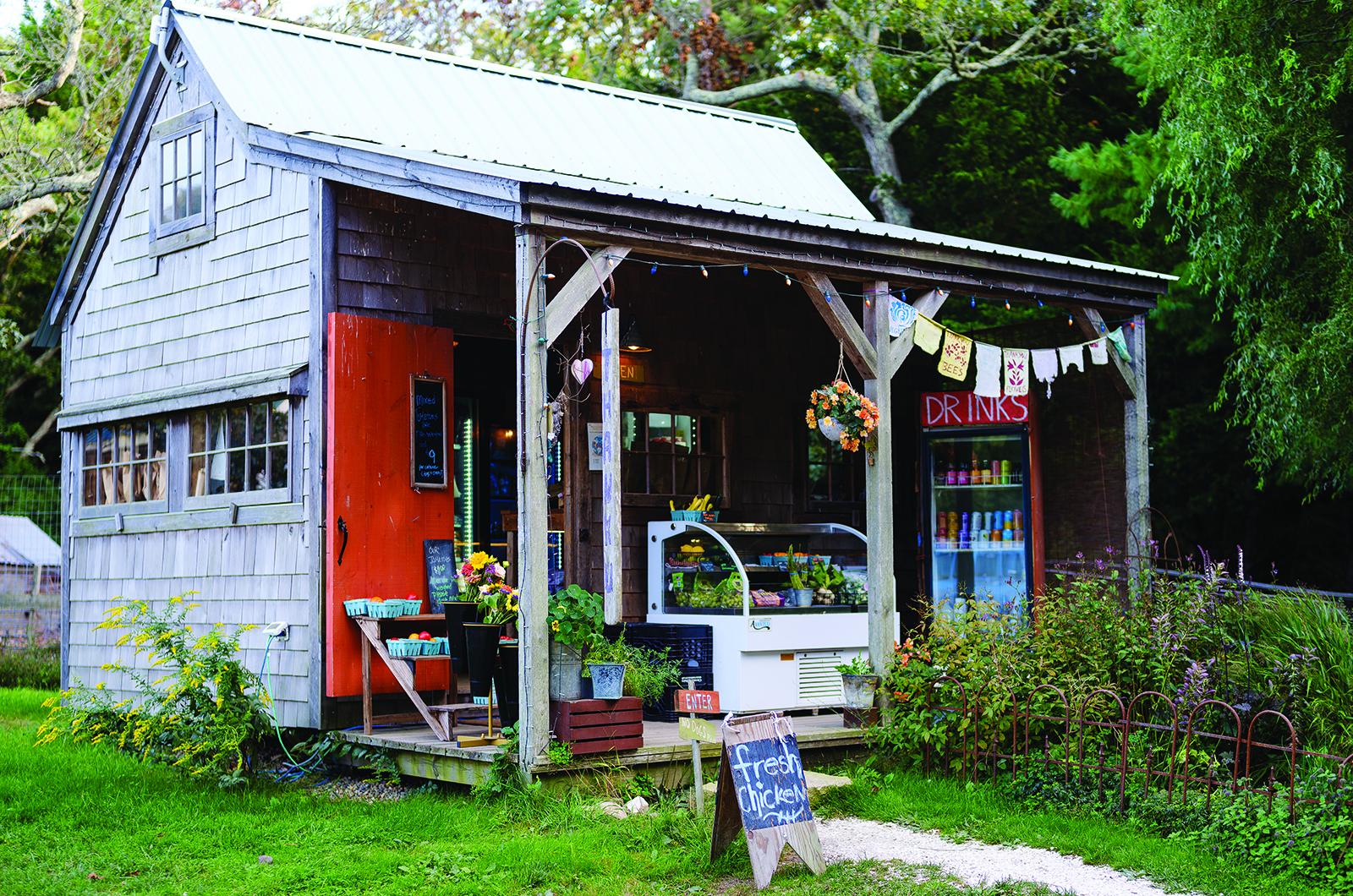
Rebecca Miller – one half of the husband-and-wife duo that founded the farm more than thirty years ago – moves easily through it all. She pauses to look at the nearby farm stand, a ten-by-sixteen-foot wooden platform structure adorned with prayer flags. Inside, warm wood and soft light frame a system built on trust: an iPad resting beside handwritten signs, neatly arranged jars, and baskets of vegetables that patrons pay for using the honor system.
“There are a lot of good farm stands on the Island; we all buy from each other,” Rebecca said with a small smile that suggested both pride and perspective. Rather than engage in outright competition, each farm participates in a shared rhythm – fields and families connected across the Island, each one growing, gathering, and giving. They are sustained as much by each other as by the land itself.

Rebecca’s own contribution to the Island farming scene took shape through a series of turns that, in hindsight, feel almost inevitable. She and her husband, Matthew Dix, met in Seattle, Washington, when he was living in a van. Rebecca offered him a place to park. Both had roots on the East Coast: Matthew is from Vermont, and Rebecca’s family had rented a house on Chilmark Pond when she was a child. So in 1990, they landed on the Island in mid-summer, caretaking a property on the edge of Tisbury Great Pond. There were chickens scratching in the yard, a garden already growing, the ocean just behind. It was enough to make staying feel less like a decision than a certainty.
Matthew soon began working for the Martha’s Vineyard Land Bank Commission and the couple put down roots of their own, purchasing a modest home in Vineyard Haven. While working for the land bank, he found out about a potential affordable housing lot along North Road in Chilmark that could also support agricultural use. For a year, he and Rebecca worked with town officials to develop a plan for a designated farm parcel. When the process concluded, their proposal was accepted. They opened North Tabor Farm in 1994.

Over the years, Matthew and Rebecca expanded their farm and their family. Between the years of 1996 and 2002, they welcomed three children: Sadie, Ruby, and Josh.
“We played outside all the time. We got to raise animals, learn how plants grow, meet really cool people from all over the world,” recalled Sadie, now twenty-nine years old. Workers doubled as babysitters; the farm itself doubled as a playground.
“I always say, if anyone ever got the chance to grow up again, they should do it on a farm on Martha’s Vineyard.”
Though life on the farm was often idyllic, it was not without tight budgets and hard work. They watched as other farms scaled back and shifted. Others sold or changed course to appeal to a more upscale clientele. Through it all, North Tabor remained rooted where it began: committed to the kind of farming that serves the Island year-round, and to a community that depends on that consistency as much as it values change.

As the kids grew up, they took on roles inside – and just outside – the farm’s orbit. Sadie works full-time as an executive assistant for an Island foundation while also handling the digital and administrative backbone of farm operations: Instagram, newsletters, record-keeping, the website, payment systems, and the like.
“They don’t pay me. I’m a free employee,” she said with an easy laugh. Then, more seriously: “It’s my way of contributing to the family.”
The youngest of the three Dix children, Josh, now twenty-three, works for Vineyard Generator but helps when needed. A self-described gearhead, he keeps the tractors, cars, and generators running smoothly.
And then there is twenty-seven-year-old Ruby, who has stepped most fully into the life her parents built – and into the future of North Tabor Farm.

“She’s the best of Matthew and the best of me,” Rebecca said of her interest in the family business. “Ruby always loved it.”
Ruby left the Island for college but returned in 2021 with both knowledge and instinct. Today, she is the farm manager. “I oversee everything to do with veggie growing,” she explained. That includes ground preparation, seeding, planting, harvesting, and planning the farm for the next season.
During peak months, she manages a crew of three to seven people, overseeing the daily choreography of a working farm while also thinking months ahead.
“We have three full-time crew members who work from April to the end of October, and one to two part-time crew members who help with the animals or harvesting during the peak of summer,” she said. In the off-season, it’s just her and her parents.
Their shared commitment to far-ahead thinking is part of a larger transition. After more than thirty years of farming, Rebecca and Matthew are beginning to pass the farm into Ruby’s hands – they aren’t stepping away entirely, but shifting the weight of decision-making, trusting her to carry both the land and its legacy of community-focused farming forward.
***
Every farm on the Vineyard has its unique thing. Some lean into flowers, eggs, or dairy; others are known for corn or bread. At North Tabor, it’s all about the greens.
Their bags of Peace Greens have become something of a calling card – a blend born out of Rebecca and Matthew’s insistence that salad should be more than just a base. It’s brighter, spicier, more textured than a standard mix: mizuna, red Russian kale, tatsoi, green and red mustards, and other varietals.

Alongside it, they grow a delicate Fancy Lettuce mix. Both blends show up regularly on Island restaurant menus. At home, Sadie eats them like potato chips – right out of the bag. “It’s not just a vessel for other things. It’s actually enjoyable on its own,” she said.
Beyond the greens, the farm produces an abundance of crops, from carrots and broccoli to shiitake mushrooms and blueberries. Some crops, such as husk cherries – small golden fruits encased in paper skins – are grown sparingly. “They’re really popular,” Ruby said, “but very tedious.” Others, such as tomatoes and baby summer squash, remain consistent bestsellers.

Ruby’s favorites reflect both practicality and pleasure. She loves growing melons and giving them to the crew as a treat when the Island air turns thick and the fields shimmer in the heat. She equally loves salad turnips, which go from seed to harvest in just forty days.
In the past few years, the balance between where North Tabor’s food goes and how it gets there has shifted. Before the pandemic, the farm maintained a wide network of wholesale restaurant accounts. During the uncertainty of Covid, that model paused and the family turned their focus inward. That spring, the family replaced an open-air roadside stand with an enclosed structure. In addition to their own products, they added a small selection of grocery items, including cheese, broth, probiotic sodas, and tofu.
In those isolating first months, the new farm stand served as a lifeline for customers, offering a safe outdoor place for people who didn’t feel comfortable shopping in town. It also served as a lifeline for the farm; direct-to-customer sales helped to keep it afloat.

In 2023, the family leaned further into that model and launched NTF Kitchen, a commercial kitchen located behind the farm stand. Under the guidance of Kyle Bullerjahn, a chef and Ruby’s partner, they began producing a variety of prepared meals, dips, dressings, and spreads available on site and at the West Tisbury Farmers’ Market.
Doing so allowed the family to maximize profits and reduce food waste. “It’s a way we can use excess vegetables or seconds,” Ruby explained. But it also opened up a world of possibilities.

Last year, for instance, they enlisted Andy Magdanz of Martha’s Vineyard Glassworks in West Tisbury to help build a wood-fired oven on the property. On select evenings from spring to fall they offered take-out pizza with seasonal toppings. It was informal, said Sadie, “but a nice way to showcase everything we were growing.”
This year, the family hired Irene Wong to serve as lead chef through November. Wong, a producer and director of national cooking shows, quickly set to work transforming the farm’s seasonal bounty into a variety of dishes that highlight and celebrate the ingredients. Early offerings included biscuits with strawberry butter, yogurt with granola and zucchini jam, and egg salad studded with garlic chives and green onions.

These kinds of additions – pizza nights, prepared foods, a thoughtfully stocked farm stand – signal a larger effort to ensure the farm’s future without compromising its identity. There is no outside investment, no expansion for expansion’s sake. Instead, growth happens organically, shaped by necessity, creativity, and care.
That philosophy extends to how the farm operates environmentally. While not strictly no-till, North Tabor practices low-till methods whenever possible, using techniques such as solarizing beds to reduce weeds, cover cropping through winter, and minimizing soil disturbance with alternative equipment. Solar panels, partially funded by a USDA grant, now contribute to the farm’s energy use.
Community, for Ruby, remains at the center of it all. “It’s having a network of people who support each other and have a shared respect and love for our Island,” she said. It’s a definition that is visible in everything from long-standing wholesale relationships, which have slowly returned, to the steady stream of customers who visit week after week.

And then there is the quieter rhythm of family. Sadie stops by often, sometimes so casually her parents don’t even know she’s there. Josh lends a hand when machinery needs fixing. Family dinners happen when the season allows.
“It’s really sweet to have everyone here,” Sadie said.
For Ruby, the future of the farm is less like a question and more like an open continuation. “I don’t know what my future holds,” she admitted. “But I’ve loved farming since I was little. I think I’ll always be a farmer and will remain part of this farm in some capacity.”
The land has already shaped one generation. Now, as the next steps forward, it carries with it not just rows of greens and tomatoes but the accumulated care of decades.
Out by the road, a sign still says it best: “No need to HOG, we have plenty of egg-selent sales.” Here, even the jokes are part of the rhythm – small reminders that this is a place built on joy, continuity, and enough community to keep it going.