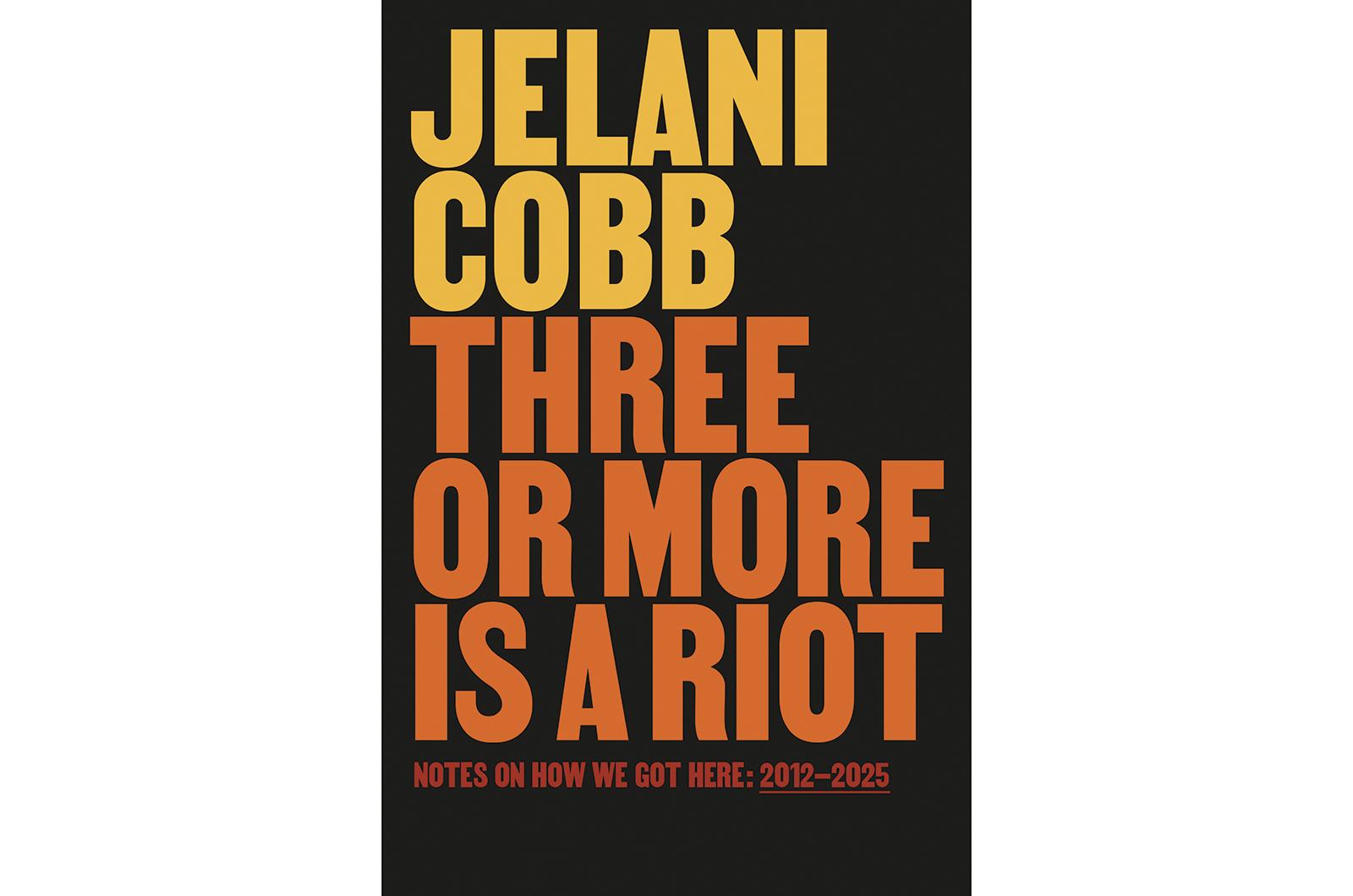
Jelani Cobb is a busy man. When he’s not reporting from the scenes of some of our country’s most fraught moments of social unrest, he’s at his desk, writing pieces for The New Yorker that situate in-the-moment observations into a uniquely wide perspective, informed by his past as a historian. He’s also the dean of the Columbia Journalism School. And he played himself in an episode of a Marvel television series. And, somewhere amidst all that, he’s written several books, including a history of hip-hop and a meditation on Barack Obama’s presidency. His latest book, Three or More Is a Riot: Notes on How We Got Here: 2012-2025 (One World, October 2025), looks at the social movements and resulting backlashes of our era in this country.
Do his annual trips to the Island provide him some much-needed peace and quiet to recover from all the action? Nope, he’s busy here too. Case in point – on July 26, Cobb, along with attorney Lee Bollinger, will be speaking at the Martha’s Vineyard Performing Arts Center in Oak Bluffs as part of the Martha’s Vineyard Author Series about another critical topic: free speech in the press and on college campuses.
In a recent conversation with Martha’s Vineyard Magazine, Cobb looked back to both our country’s beginning and his own past, forward to our collective future, and squarely at the present moment. An edited transcript follows.
Martha’s Vineyard Magazine: Your new book, Three or More Is a Riot, touches on the history and meaning of protest. In today’s climate, do you think protest still has the same power to shape public consciousness, or has something fundamentally shifted?
Jelani Cobb: When we think about protest, it’s one tool in the arsenal of people seeking social change. But it’s what people have been doing for literally hundreds of years. The American and French Revolutions started as a series of protests. For all that time, people have instinctively sought to gather, and to articulate their purposes and to air their grievances. So, I think it’s still important, and at the same time, we’ve seen the effect of surveillance technologies – people can be doxxed. We’ve seen increasing state repression in places around the world, including the United States. It is much more difficult and risky to take to the streets to protest or to voice your opinion than it once was, but I still think that it has validity and utility as a tool.
MVM: You’ve described the book as a three-act play. Can you describe the three acts?
JC: When I was looking at the pieces I’ve written over the preceding twelve years, it occurred to me that the first portion of them were in response to the Obama administration, the second portion of them came in response to the Trump administration, and then the final part was things that I wrote during the Biden administration up to the return of Trump. If it had been a drama, those would be the three acts, and then there’d be a little coda for the 2024 election.
MVM: The play metaphor is compelling. Did you see this time as especially dramatic or theatrical?
JC: Absolutely, yes. It was the second term of the first Black president, 2012 to 2016, and then we have the rise of this right-wing populist movement associated with Trumpism – the MAGA movement. Then we have a pushback that comes against it, in the midst of an international, global pandemic, along with all the other societal conflicts that took place – including George Floyd – in the election year of 2024. I think that all those things lent a particular kind of dramatic sensibility to it.
MVM: What kind of play do you think this is? Tragedy? Comedy?
JC: Shakespeare wrote tragedies, comedies, and he also wrote histories. So, I would say that it’s probably a history that has tragic elements to it.
MVM: You have a background as a historian. As the country approaches its 250th anniversary, there’s a sense that we’re both celebrating our history and arguing over it. What do you think readers of your book might take away about our history as a nation and where we are today?
JC: As we think about the founding of the country and where we’ve gotten to today, I do think the book tips its hat to some of the themes that have been recurrent in the nation’s history. We see this dynamic of progress and backlash, which happened with slavery and Reconstruction and post-Reconstruction. It happened with the Civil Rights Movement. We see these themes of the nation’s deep ambivalence about immigration, which I touched on in some of the things that I wrote. The book goes through some of the cycles that would help highlight or facilitate understanding of what the nation has been about and what it’s experienced in all these years.
MVM: What do you think is at stake when a nation begins to blur – or deliberately rewrite – the story it tells about itself?
JC: I think that when you lose touch with that narrative, you actually are in line for a story that’s tragic. Everything that we can hope to aspire to has to be informed by the cumulative knowledge that we’ve developed over the course of our existence, which we know of as our history. Without that, you’re liable to make the same mistakes in the same way that you did before, which I thought was one of the most transparent elements of the attempt to remove, for instance, the plaques about slavery from the President’s House monument in Philadelphia, or any of the other National Park Services that have been revised to kind of airbrush the more difficult elements of American history.
MVM: You’ve spent your career examining the way race and our feelings about it have shaped our past. How do you see the future of our country through this lens?
JC: It’s become popular to have this pessimistic sensibility, but I don’t think of it that way. When you look at the arc of these struggles, there’s a particular kind of long-term momentum. It’s like the difference between weather and climate. You can have a cold day, but the overall trend of the weather can be getting warmer. I think we have a difficult moment, but it’s possible that the overall trend is toward a more egalitarian society. And that possibility alone makes it worth continuing to pursue that idea.
MVM: Between your work at The New Yorker and your role as dean of the Columbia Journalism School, I imagine you see both the practice and the theory of journalism up close. What about journalism feels most at risk right now?
JC: We’re in a climate of a kind of casual repression of press freedom. As we speak right now, the journalist Ahmed Shihab-Eldin has been detained and arrested by the Kuwaiti government for doing nothing more than reporting on what’s going on, the hostilities that are happening in Kuwait as a result of the war between the United States, Israel, and Iran. I wish it were an exception, but we’ve seen a great deal of that around the world.
Then there are the business model things, the AI things, the technological challenges, the loss of trust. But I also want to emphasize that, amid that kind of hostile environment, we still see journalists getting up every day and going out and doing the important stories. Even as the public will say that they don’t trust us, they still turn to us, particularly in moments of crisis, to find out what’s going on. There are some things that are eternal, and one of those things is the importance of telling the truth in the public interest.
MVM: When you were a student at Jamaica High School in Queens or at Howard University in D.C., what or who had the greatest influence on who you are today and the work you do?
JC: My professors at Howard – one in particular was named Adell Patton, who was a historian – made me really want to understand the dynamic interaction between the past and the present. I also benefited from going to Jamaica High School, which I talk about frequently because I believe in the ideal of public education and the possibility that people can receive a quality education in a public school, which is what happened with me.
MVM: You sound very busy. How often are you able to visit the Island? What do you enjoy doing while here?
JC: We typically come once a year, although a couple of times we’ve come up twice, and we’ll usually be there for a week to ten days. Me, my wife, and our three children, we tend to hang out in Vineyard Haven. Of course, our kids like the carousel in Oak Bluffs, the beach. We’re often going to friends’ homes to hang out and eat dinner together.
MVM: Martha’s Vineyard has long been a place where people come to think, write, and step outside the noise. Do you find that the Island gives you a place to relax and think?
JC: No! [laughs] Maybe some people have figured that out, but when I get to the Island, there are usually thirty people I know who’ve heard that I’ve arrived. There are a bunch of different social engagements. I do not get quiet. It is not quiet when I’m there.