


Ariel Ashe designs spaces the way some people tell stories: layered, intuitive, and deeply attuned to mood. She is the cofounder of Ashe Leandro, an architecture and interior design firm known for spaces that balance structure with soul. Raised in New Mexico and educated in scenery and lighting design at New York University, Ashe’s background informs her cinematic approach to interiors. Her connection to Martha’s Vineyard began serendipitously in 1989 after a hurricane rerouted her family’s travel plans, eventually leading to decades of summers on the Island. A few years ago she designed and built her own Vineyard farmhouse in Chilmark shaped by Island light and texture.
Recently, Ashe spoke with Martha’s Vineyard Magazine about her home, the rhythm of Island life, and who she’s most likely to be found hanging out with here in her free time. (Spoiler alert: it’s not her sister and famous brother in law.) An edited transcript follows.
Martha’s Vineyard Magazine: Let’s start with your Vineyard home, a farmhouse in Chilmark. What drew you to that style?
Ariel Ashe: There was a house in Menemsha that I always loved. It was a tiny house with a big porch and I sort of used that as inspiration and adapted that to fit what I thought our family would be at the time. I was pregnant when we started construction in 2019, so I knew we would have at least one child. I knew I wanted two guest rooms and one kids’ room, so I adapted the style of that Menemsha house for the site.
MVM: You divide your time between New York City and Chilmark. How does moving between those two worlds shape the way you think about space, pace, and design?
AA: I definitely have a city–country mouse thing going on. Everything on Martha’s Vineyard is paced slower, and without shoes. And on the Vineyard you need to consider the air and the light. Colors are different and textures are more important. My floors are wire-brushed oak to absorb the sand rather than fight with it.
MVM: How does the Vineyard landscape inform your material choices and interior palette when designing here?
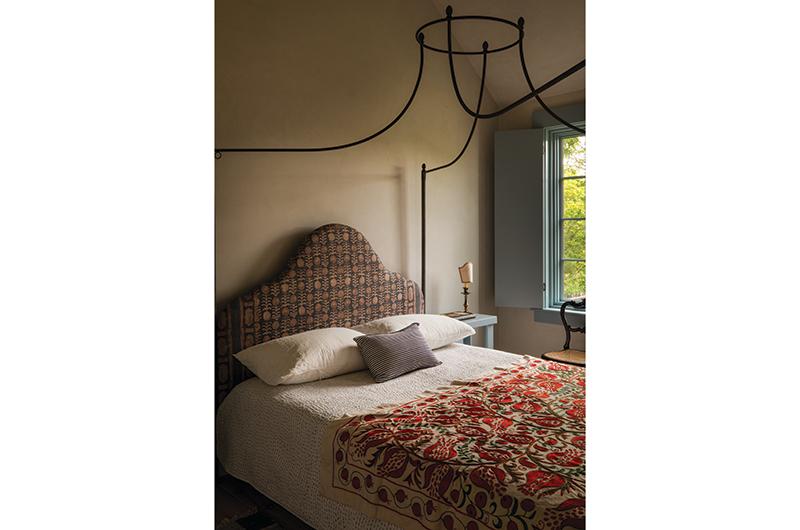
AA: My partner [Reinaldo Leandro] and I started designing for young families; that was our bread and butter for the first five years of our practice. So, my work has always been geared toward keeping things livable. And on the Vineyard you have to keep it extra livable – fabrics that will wear indoors and out and not grow mold because it’s often damp. I like plaster and stone and wood, and that all works very well on the Vineyard. It’s just in a bit more rugged of a state. And I find you don’t need to supplement with very much color. The Island does that for you with its scrubby pine trees, hay fields, and blue, blue ocean. In my home, I wanted morning sun in the kitchen and evening light in the bedroom. At my parents’ house, my bedroom faced east and as a kid it was nice to wake up to that blast of sun. But now I want the opposite.
MVM: Sustainability and stewardship feel especially urgent in coastal communities. How does environmental responsibility show up in your Vineyard work?
AA: I love using solar power where we can…. I like to try to live as clean as possible, so my house has a natural cedar exterior and no painted trim, which helps with maintenance and upkeep and also just keeping the VOCs [volatile organic compounds] out of the environment. I try to keep the materials as East Coast–style and as local as possible.
MVM: Are there particular Vineyard features, such as outdoor showers, porches, and communal tables, that you think deserve special architectural attention?
AA: Every house needs to have all three of those, for sure. I love a porch, because if it rains you can still be outside. I think that’s why I was inspired by that Menemsha house; I always wanted to have a big wrap-around porch. At my parents’ house, the outdoor shower is inside the porch, so it’s still covered but you can shower in the rain and it feels like you’re showering outside, which is amazing. And communal tables everywhere – we usually have like twenty people for dinner every night, with some combination of family and friends and kids and friends’ kids.
MVM: Let’s talk about your book, Ashe Leandro: Architecture + Interiors, by Ariel Ashe and Reinaldo Leandro (Rizzoli, 2024) which explores ideas of identity, narrative, and place. We can’t ignore the fact that you open it with a foreword by your brother in law, Seth Meyers, which immediately disarms the reader. Why did humor, and that particular voice, feel like the right way to introduce your work?
AA: I think we’ve always tried to incorporate humor into our work so that we don’t look like we’re trying to take ourselves too seriously. Home design shouldn’t be that serious; it should be personal and accessible and easy to live in, and it should make you happy. And who doesn’t like to laugh? So why not open it that way?

MVM: The book balances museum-quality interiors with personal narratives. How important was it that the book reveal how these spaces are lived in?
AA: Reinaldo really took the helm of the book, figuring out the format and visuals. Understanding how the clients live and the architectural context and building site are very important to the success of a project. If it’s an apartment in the Upper East Side, it should look like that. You wouldn’t do an industrial style build in a pre-war building. A farmland site is different from a site nestled in the dunes on the North Shore. And by nature of that, the design will be different and the clients will move around the spaces in their own way.
MVM: Looking back at your book now, are there ideas in it that feel especially aligned with the Vineyard way of life?
AA: My sister’s house is one of the projects in the book. My sister [Alexi Ashe] and Seth let us do whatever we wanted to do; they trust us that we know how they live and we know what they want, so we got to flex what an ideal Vineyard house would be.... We got to use all our Vineyard ideas there: double outdoor shower, outdoor bathtub, giant porch, thirty-foot-high fireplace, reclaimed timber frame. And I got to use Eben Armer for the stonework, who I had admired for so long. He dug a giant boulder out of the landscape and built a massive outdoor fireplace on top of it.
MVM: Oh, that’s exciting! Tell us more about the house.
AA: I was inspired by the old Hornblower barn in Squibnocket. We started with a simple barn shape and carved the living spaces into that. It feels like there are a thousand doors to the outside, so it’s almost indoor-outdoor living. There’s a fifty-foot porch on one side where the family spends all day into dinner and a table that seats sixteen. The living room is anchored by an algae-green carpet that reminded me of the moss around all the trees. And the sofa is slipcovered for easy washing.
MVM: When you’re on the Vineyard and not thinking like a designer, where do you feel most at home: inside, outside, or somewhere in between?
AA: I feel most at home when I’m with my chickens. During Covid I bought a chicken coop...and it just became my favorite thing. Honestly, I spend all my time at home down in my chicken coop just feeding my chickens, hanging out with them, and messing around.