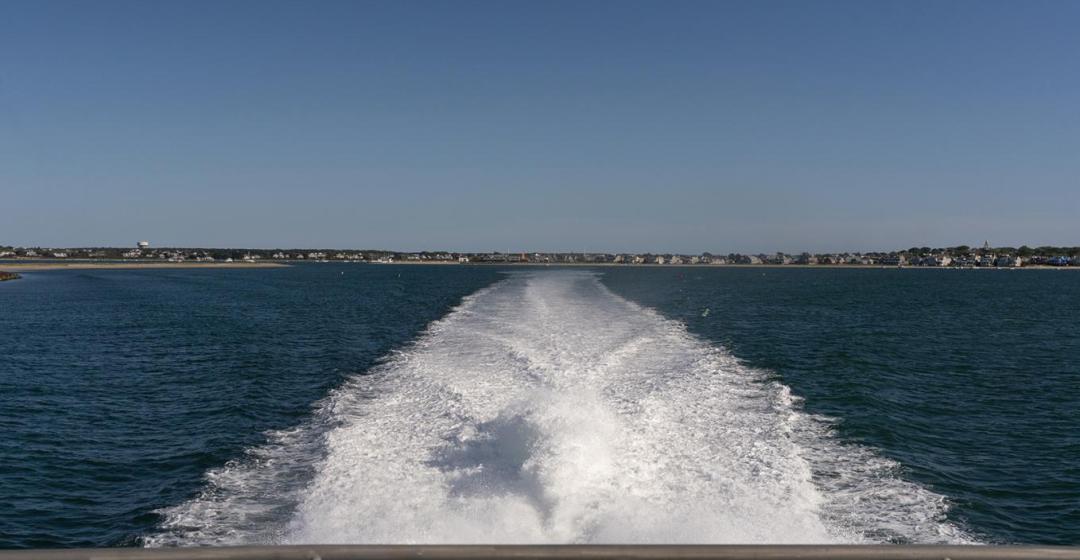


I grew up on Martha’s Vineyard and not once in those seventeen years did I ever consider visiting our island neighbor, which sits a mere thirteen miles away. It wasn’t that I didn’t think there was anything of value to find on Nantucket – it was more that I didn’t think of Nantucket at all. Eventually, the question of why I hadn’t stopped to consider this 47.8-square-mile piece of land as a place as real as our home, with its own businesses, schools, town meetings, and housing issues, began to nag at me.
I started to ask fellow Vineyarders if they’d ever been to Nantucket at any time, for any reason. Again and again, the answer was no, even from people who’d spent forty or fifty years on Martha’s Vineyard. Their responses ranged from a sheepish “haven’t gotten around to it yet” to what I have to admit was a familiarly defiant “why would I?”
So, why would we? The obvious answer is that Nantucket is a beautiful island with a rich history. People from around the world visit Nantucket for its beaches, restaurants, galleries, and general quaintness. In essence, they go supposing they’ll have a good time.
As for why we don’t go to Nantucket, I suspected there might be some intrinsic tribal resistance at play, some reluctance from people who had, whether consciously or not, built their identities on the idea of living in a unique place and didn’t want to confront the place most like their own home. After all, how special are you when your twin is just a few nautical miles away? Looking for answers and trying to find some fellow Vineyarders enjoying themselves on our sister island, I booked a trip.
•••
There are two direct means of travel to Nantucket from Martha’s Vineyard. One is a plane ride with Cape Air and the other is the Hy-Line Cruises’s inter-island ferry, an hour-long trip that’s offered from May to October. This ferry is the only direct, commercial, marine passage between the islands. Cape Air flights, which last less than half an hour and cost $99, are available year-round.
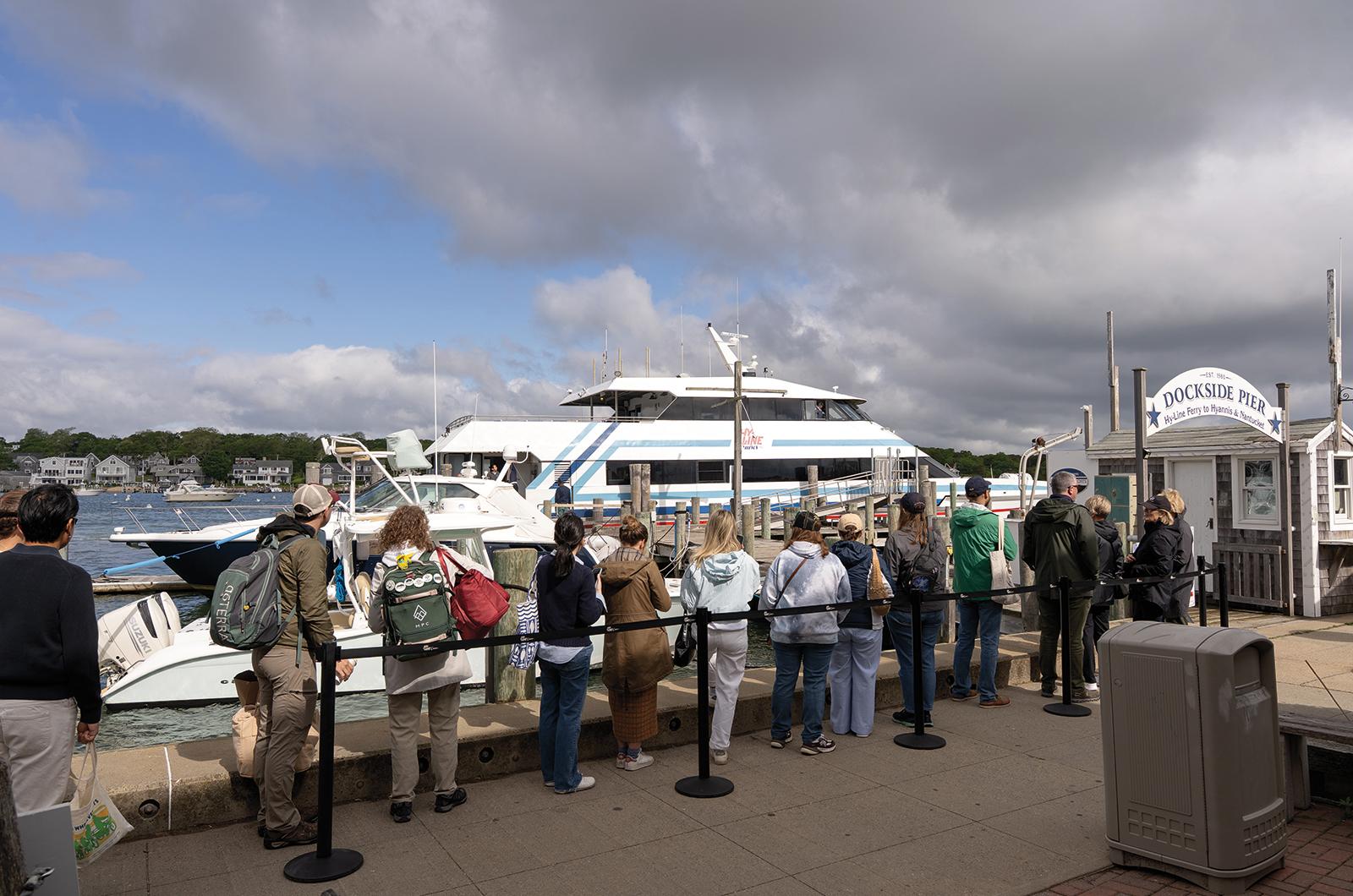
It was a warm fall day when I set out. A crowd of about twenty-five people waited at the Hy-Line dock in Oak Bluffs. The gingerbread-style eaves of Coop de Ville and the Sand Bar & Grille were behind us, and the harbor, packed with sailboats and yachts, opened up beyond. Some of those gathered had a wide-eyed look which, paired with crisp, white clothing and large tote bags, said “tourist.” I eavesdropped on conversations, listening for mentions of local-coded topics, but it was mostly small talk about the weather “back home,” or the sights they had seen while “in” Martha’s Vineyard. Where were the other Islanders?
Finally, a woman in sunglasses and leggings came and promptly sat down perilously close to the edge of the dock. She pulled out her phone and was tapping away until I approached her. Her confidence and comfort in the space had me suspecting she was a local, and my hunch was right. Her name was Sarah Mae Barker and she did live on the Vineyard – but she wasn’t going to Nantucket to have a nice time.
“I bank at Bank of America and the closest location is on Nantucket,” she said. She’d take a return ferry home that day. For her, this was just a long work commute.

When it was time to depart, I followed the line of people up the gangplank and onto the ferry, which appeared to sell the kind of refreshments available on the Steamship Authority ferries, except no one was there to sell them. I sat by the window and watched as we headed out toward a destination I’d never traveled: further out to sea. Finally considering the fact that there was another island out there felt like realizing there was another person in a room I’d thought was empty.
For most of the ride, only open ocean was visible: blinding sun on blue-gray waves. Until about 8,000 years ago, there wasn’t ocean here at all. At that time, both Nantucket and Martha’s Vineyard were connected to the mainland as one landmass, formed by the movement of massive ice sheets during the last Ice Age some two and a half million years ago. These sheets, which were up to two miles thick, inched down from the north and, like bulldozers, pushed huge mounds of earth and stone ahead of them, which was deposited and formed the land. Then sea levels rose and separated Nantucket and Martha’s Vineyard – still connected as one landmass – from the mainland. It wasn’t until fifteen hundred years after this initial split from Cape Cod that rising water separated the two islands from each other.
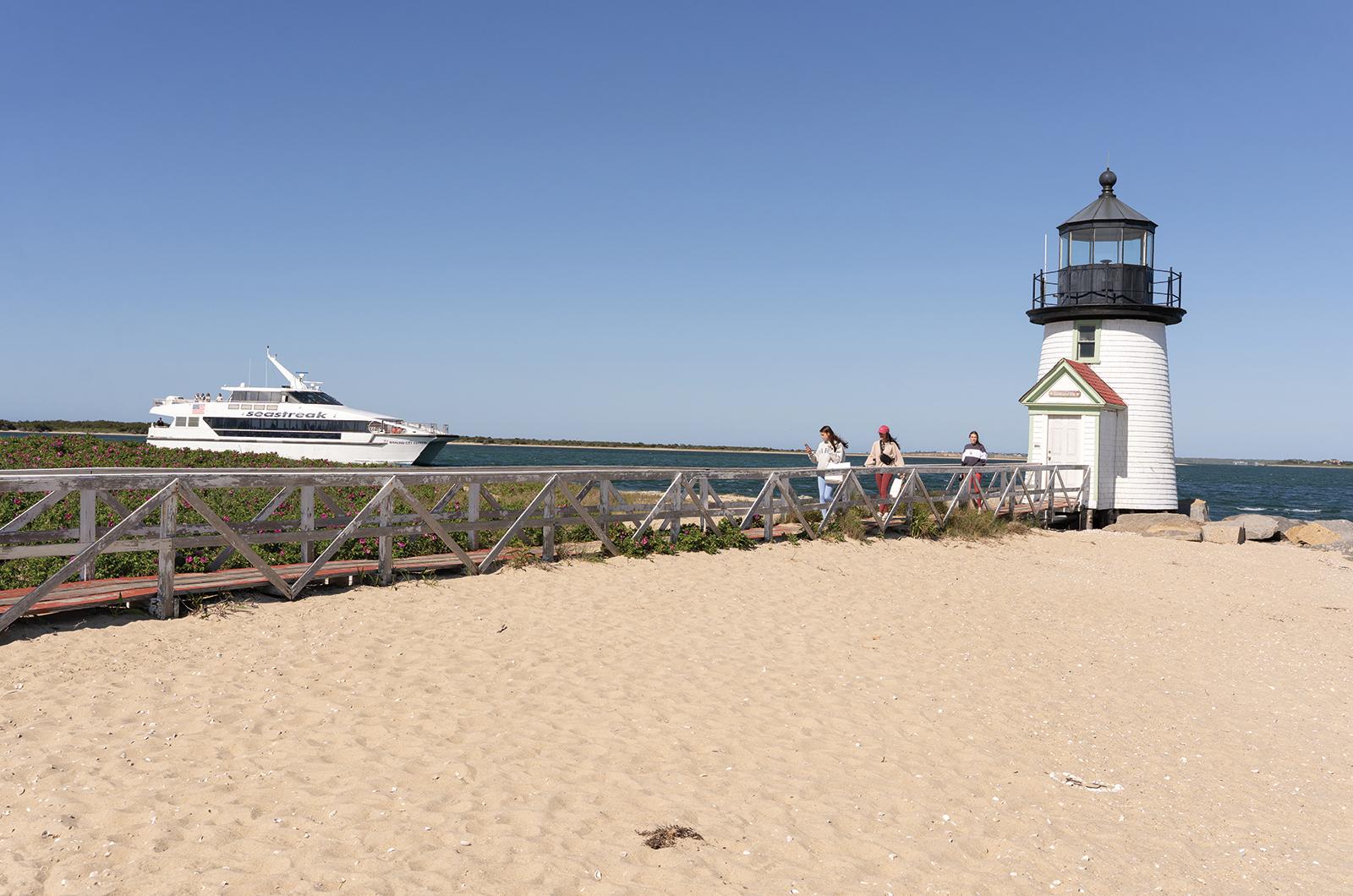
Finally, the ferry engine downshifted and, as I caught my first glimpses of Nantucket, I felt a small wave of anxiety. We idled, approaching slowly. There was a lighthouse on a beach surrounded by children playing. A hodgepodge of small shops with weathered shingles and hand-painted signs. Winding streets and a church spire. It looked uncannily similar to Martha’s Vineyard. Like something out of a horror movie, my home had been copied and pasted. We docked and I followed the line of passengers out of the mouth of the ship and into the bright sun.
•••
Seagulls called. A man stood by the docks holding a sign that said “Nantucket Hotel.” I, along with a young couple, followed him to the hotel’s shuttle van. As we settled in, I asked them where they were coming from but struck out again: they were just visiting both islands as part of their honeymoon. Even these mainlanders had noticed that visiting both islands wasn’t the norm. “People seem to pick an island and go there,” the woman said. “It’s part of their identity.”
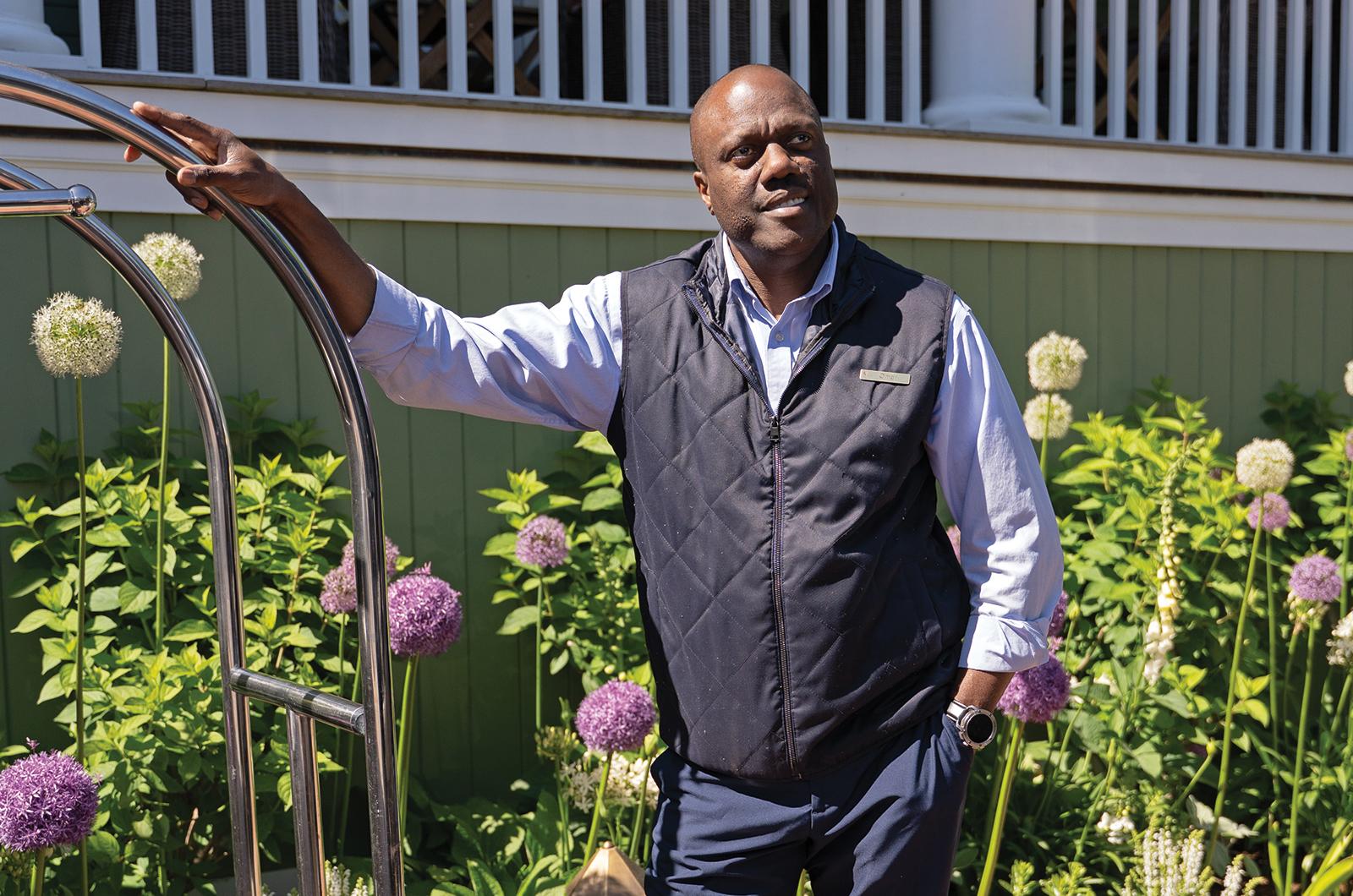
The driver introduced himself as Omar Campbell and welcomed us warmly in an accent that seemed to come from another island. “I’m from Montego Bay, Jamaica,” he said, adding that there are a lot of people from Jamaica on the island. “We spice up Nantucket,” Campbell laughed. “They love us. You know, hospitality is our world.”
It’s true that Nantucket’s year-round population is relatively diverse, and this is perhaps best seen in the classroom. According to the Department of Education, the largest ethnic group at Nantucket Elementary School, which serves pre-K through second grade, is Hispanic or Latino at 51.1 percent for 2025 and 2026. The percentage of white students is 31.4. Statewide, school enrollment for these two groups is 26.2 percent and 50.8 percent, respectively.
After a short drive, we arrived at the grand nineteenth-century shingle-style Nantucket Hotel, which bills itself as the island’s only year-round resort. It was originally opened in 1891 as the Point Breeze Hotel. After mostly burning down, being rebuilt, and changing hands several times, the hotel was purchased by the Snider family in 2011 and reopened in 2012 under its current name. I asked the woman at the front desk if there were any other Vineyarders staying here. I’d booked my stay during something called Islanders Stay Free, a program run by the Sniders, who also own the Vineyard’s Winnetu Oceanside Resort. Locals from one island are invited to stay for a night in the hotel on the other island for the price of a cleaning fee and a meal in the hotel restaurant. Yes, she said, there were other Vineyarders staying there, and gave a closed-mouth smile.
•••
My hotel room was white and bright and vaguely nautical. The bed’s throw pillows were printed with a blue sperm whale. The island’s whaling history is known around the world, thanks in part to Herman Melville’s Moby-Dick, a novel that drew from the real story of Nantucket’s whale ship Essex.
Melville, who was born in New York City and lived in Massachusetts, wrote Moby-Dick without ever having visited Nantucket. A line in a chapter called “Nantucket” told readers to “Look at it – a mere hillock, and elbow of sand; all beach, without a background.”
To properly “look at it,” I signed up for a guided walking tour from the Nantucket Historical Association, which was meeting soon. On the way there, I passed crews of people working on construction projects, likely taking advantage of the departure of the homes’ seasonal residents. Reggae music emanated from boom boxes as ladders were extended and scaled.
Soon, I had gathered with a small group on the brick sidewalk outside the museum. Our red-headed tour guide introduced himself as Isaiah Williams, a twenty-five-year-old born and bred Nantucketer. He went around the horseshoe and asked each person where they were from. They responded with various states around the country. Then I gave my answer, and his face lit up.
“Oh, well, just for the record: we win, you lose,” he said with a smile. “Now that we’ve got that out of the way, we can start.”
•••
The mostly playful feud between locals on either island is sometimes chalked up to a long-standing sports rivalry between the two high school football teams, but the history of inter-island interaction was mostly that of interdependence, not competition. As our group walked toward Nantucket Harbor, Williams talked about the island’s past.
The first inhabitants of Nantucket were Wampanoags who established settlements when the land bridge to the mainland was still intact. Along with other types of fishing, they harvested stranded whales that washed onto the island’s shores. English settlers arrived in 1659 and took up whaling, first on short trips with Wampanoag oarsmen and later on longer voyages, with many Wampanoag crew members. At whaling’s peak in the mid-1700s to mid-1800s, the harbor would’ve been bustling and the resources required to support the whaling trade were shared by the two islands. The Vineyard provided many sailors and captains, while Nantucket was the busier port.
As the demand for whale oil decreased in the mid-1850s, tourism increased on both islands. The captains’ houses in both places were turned into T-shirt shops, inns, and cocktail bars.
Williams drew our attention to the place where Nantucketer and first professional female astronomer Maria Mitchell discovered a comet. We then trudged up a hill and stopped outside a modest clapboard box of a building. The patchy grass around it clung to sandy soil. This, Williams explained, was the Friends Meeting House. Inside, the space was austere, modest, and quiet, traits the many Nantucket Quakers valued. We sat on the worn benches in silence.
Finally, on our way back to the Nantucket Historical Association, a woman asked Williams whether the island was especially romantic during Christmastime. He didn’t pause before saying that he didn’t like to consider any place romantic, including his home island, since that perspective seemed to strip a place of its complex reality.
Once the other visitors disbanded, I asked him about this response. “The commodification and the self-awareness of how cute and quaint something can be, in my opinion, destroys it,” he said. Williams made clear that he was speaking just for himself, and not for his employer, but said that visitors do often ask him about the impact of tourism on the island. “Summer people with summer homes annoy me far more than tourists. Tourists, by definition, are here to just look and see and enjoy. And summer people make it much more of their playground.”
Williams hopes to stay on Nantucket, in the house his family owns, for the foreseeable future. He said that, without that house, there would be no future for him on the island. As on the Vineyard, property values have steadily skyrocketed. According to Fisher Real Estate, the average residential home sale on Nantucket in 2025 was more than $5 million, up 3 percent from 2024. On the Vineyard, the average selling price of a residential home in 2025 was $2.6 million, up 16 percent from the previous year, according to LINK MV, a multiple listing service.
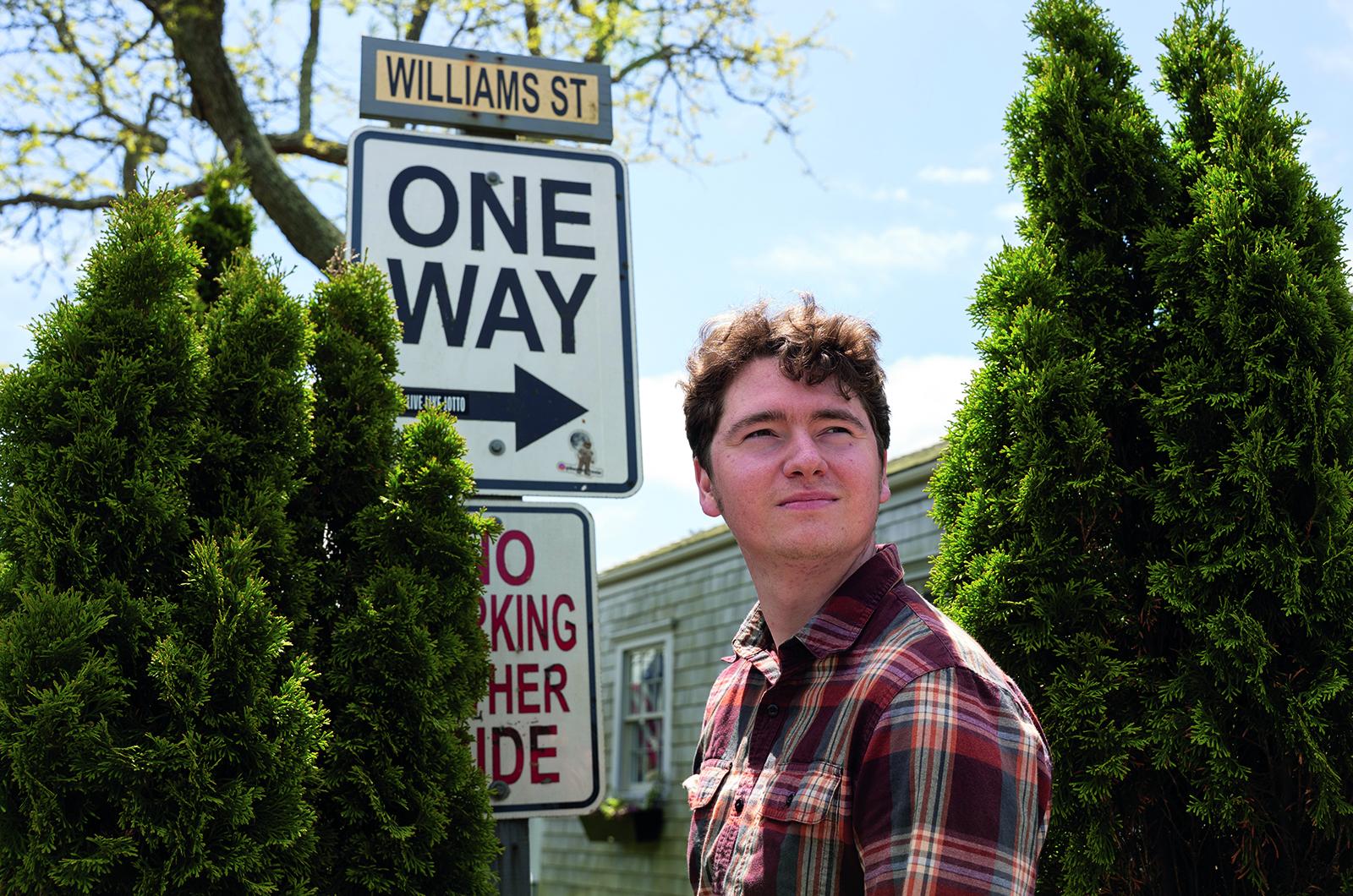
Some of Williams’ friends and family have sold their houses – including some located on Williams Street, named for their ancestors – and he imagines they’ll never be able to buy again. “You just have to keep that thing you have forever,” he said. “That’s my biggest nightmare, that all of my friends and their parents and everyone sells their houses on the same day.” A place is hardly home without your community around you.

At dinner that evening, I approached another couple thinking they may be from the Vineyard, but again I was wrong. Afterward, I stopped in the gift shop and found a sweatshirt that said “The Better Island.” A storm had begun to brew but I headed out into the darkness anyway. Glancing at menu prices earlier told me I wouldn’t be able to afford a meal out the next day, so I ducked into the Stop & Shop for some provisions. There, a flyer on the corkboard told of an eighth-grade school project. Two students were trying to gather personal stories to help support the passing of Article 86, “the home rule petition that imposes a real estate transfer fee on most transactions on the island,” the flyer said. I was wondering how many eighth graders knew about real estate transfer fees when I saw the clock above the door. It said 4:35, even though it was 7:21 p.m.
I left and headed out in the direction of the Brant Point lighthouse, which I’d seen from the ferry. The wind was howling through the neighborhood. Just like in the Oak Bluffs Camp Ground, houses on Nantucket often came with their own name on a wooden sign. The airport’s call letters, ACK, featured prominently in names such as Ack Last and Ackaholic. There was also Sea Rebreal and Consoling Proximity.
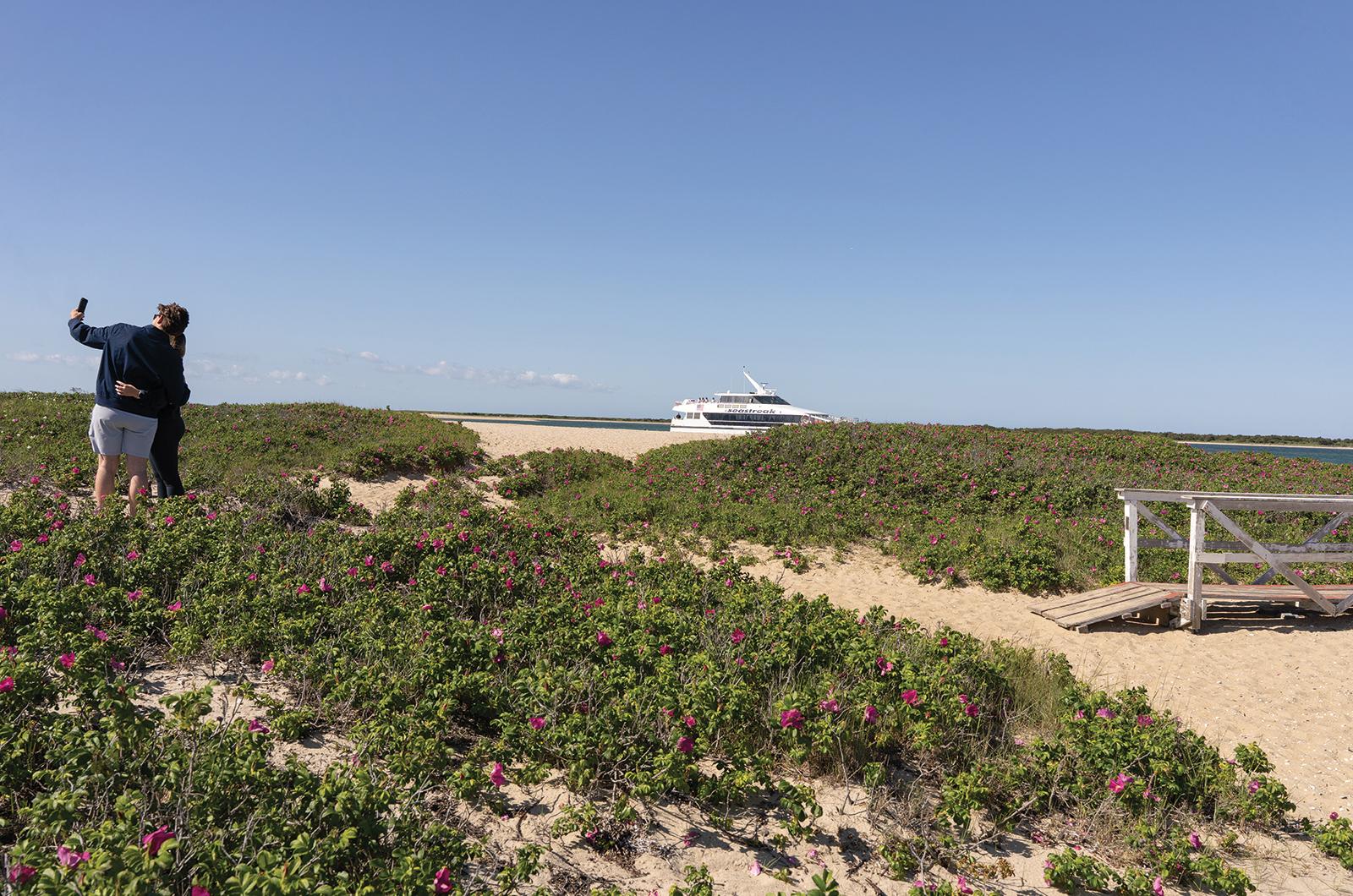
I approached the dark beach. Out past the dunes, the ocean was whipped into a foamy frenzy. At the end of the long, wooden walkway, the lighthouse blinked red against the black sky. While many aspects of my childhood on Martha’s Vineyard had been shaped by its island geography, I’d never felt remote, trapped, or stranded. But out there, on the beach, I felt the seclusion of an island in a way I never had. I wanted to turn and head back to the hotel, but I forced myself onward to feel the storm and the fear. I trudged into the flying sand and down the walkway until I was surrounded by water on all sides.
•••
It turned out that my feeling of being marooned was warranted. The next morning, with the wind still blowing, the ferries home were canceled. I hurried to book one of those puddle jumper flights leaving that afternoon, then stopped in the restaurant for coffee. The clock over the bar also said exactly 4:35, even though it was 1:48 p.m.
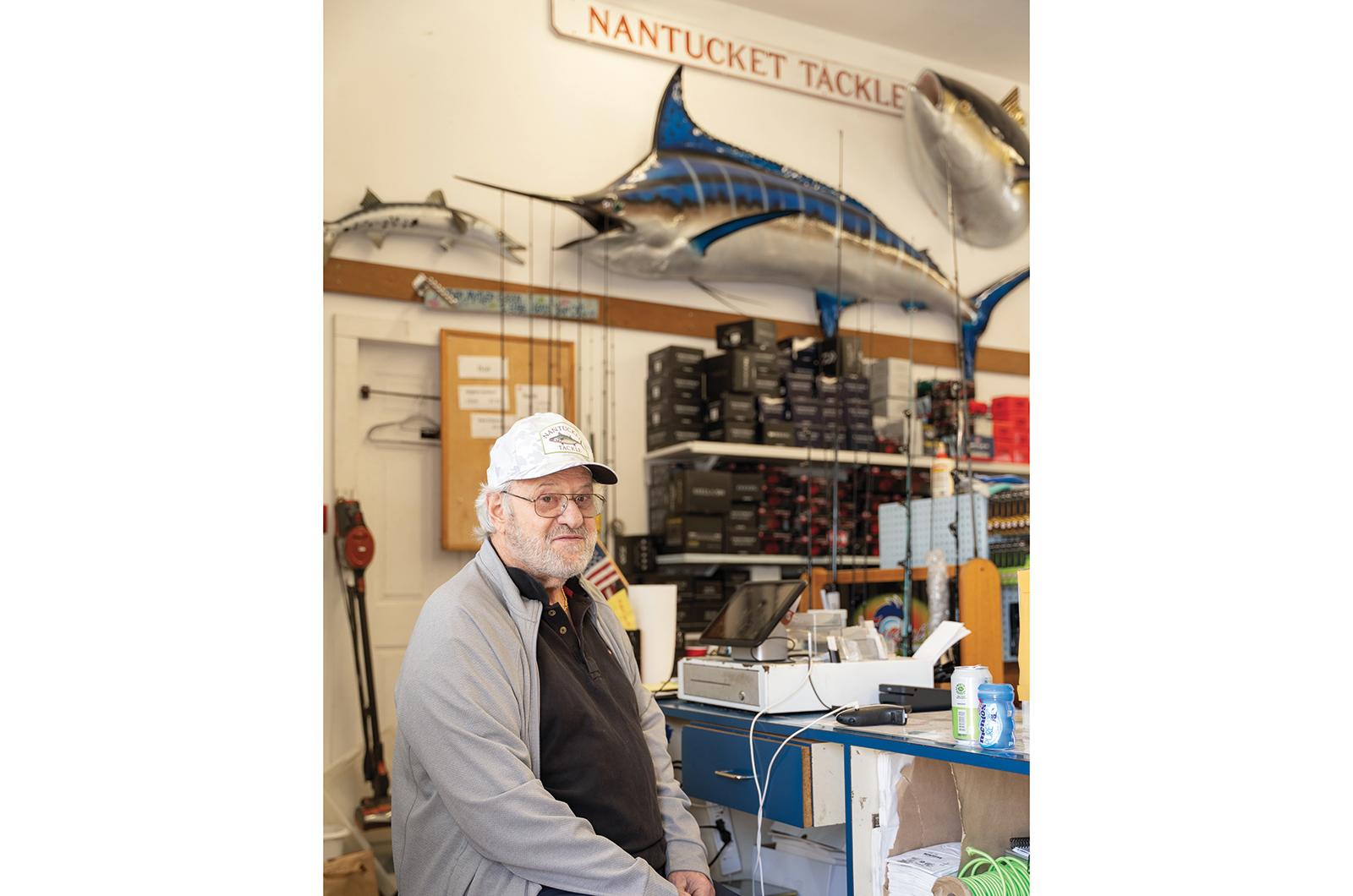
That day was my brother’s birthday and he’d asked for a certain kind of fishing lure that they made on Nantucket. At the end of a dock was a tackle shop that at the time was being manned by David Peek, who had a unique background: he’d lived on both the Vineyard and Nantucket.
“The fishing’s really good on both islands,” he said. But Nantucket has “one hundred percent accessibility.” After living on the Vineyard for six years, he’d grown tired of the private beaches and reveled in being able to drive almost all the way around his current home. Some of his friends were competing in the Martha’s Vineyard Striped Bass & Bluefish Derby. “They’re calling it the Nantucket Derby this year, because all the biggest fish have been coming from Nantucket,” he laughed.
Peek, who is originally from San Diego, moved from the Vineyard to Nantucket six years ago. He’s gotten attention for how rare his past is. Someone once interviewed him for a podcast, he said, because they’d never met anyone who had lived on both islands.
“I have the Vineyard tattooed on my arm,” he said. “So I got to get Nantucket on the other and then a steamship on my chest.”
But this direct steamship route would exist only on his body. Some of the reasons for the lack of inter-island travel among locals are purely logistical, Peek said. The Hy-Line is passenger-only. To get from Nantucket to the Vineyard with a car, you have to take a Steamship Authority ferry all the way to Hyannis then drive to Woods Hole and take another ferry from there to the Vineyard. It’s time-consuming and expensive. Plus, Peek said, he has everything he needs right here.
I bought the lures and explained that my brother had asked for them. “They sell those on the Vineyard too,” he said.
•••
Despite the Islanders Stay Free promotion, I still hadn’t found any Vineyarders on Nantucket, so I decided to call up Mark Snider who, along with his family, owns the two hotels and another one on St. John. Was the promotion designed to remedy the fact that locals seemed so loath to leave one island for the other? He said it was more about establishing goodwill among the local community, rather than catering only to visitors. He estimated that two to three hundred people participate in the promotion each year, which spans several dates in the fall.
Snider has noticed that people with a vested interest in one island don’t go hopping back and forth. “What I find is that the people who live and own real estate on either island are inherently biased, which they should be, to their island,” he said.
But this bias didn’t seem to sit perfectly with him. He asked me whether I had any siblings – yes, the aforementioned brother – and whether our parents loved us equally – yes, as far as I could tell. It was the same with the sibling islands, he said. “The islands come from the same family, they have different personalities, you can love them equally for what makes them different, because they are basically a family.”
It was partly this line of thinking that inspired me to next call Matthew Stackpole, a historian and sailor who lives on Martha’s Vineyard. He grew up on Nantucket – and he’s a twin – but he doesn’t think either thing makes him too special.
“There’s a great quote from Mark Twain where he said that you can’t get too excited about where you were born. He said, ‘I was born in Missouri so I could be with my mother at the time of the event.’ But I was indeed born with my mother at Nantucket in 1946,” Stackpole said. “Don’t do the math.”
Most people that I spoke with cited that famous sports rivalry between the island teams as a source of animosity. However, when Stackpole was young, it wasn’t easy to simply say “harpoon the whalers” and be done with it. In the fifties, the visiting players would stay at the homes of the opposing team members when they traveled for games, he said.
“Staying in somebody’s house and having dinner with them and, you know, you’re still playing hard against them, but there’s kind of a connection,” he explained. It’s harder to hold a grudge against someone while they’re passing you the potatoes.
When I asked if he saw any connections between growing up as a twin and living on twin islands, he laughed. “I think the commonalities are greater than the differences,” he said.
•••
A short time later, I sat in the Nantucket airport lobby feeling as eager to get home as I’d ever felt. I thought about the ways I had shaped my identity around being from the Vineyard. Some of it was hometown pride and some of it, as I imagine is true for many people, comes from other people’s assumptions about where I grew up. As much as I might not like to admit it, it made me feel special when folks on the “mainland” were shocked and delighted to hear that I was from such a unique place, and I enjoyed being able to entertain them with the details and occasionally break down some stereotypes.

Maybe I hadn’t spent much time thinking about Nantucket because I didn’t want to acknowledge a place that was so like my own home that its existence would have made my childhood, and my sense of self, slightly less unique. Maybe I could learn something from Stackpole, that what made a person distinct was less literal, less circumstantial.
Then I noticed the clock in the airport lobby. It, too, said exactly 4:35. I went over to the desk to ask if this was some kind of Nantucket reference, some inside joke I didn’t know about. Was it always almost five o’clock and therefore perpetually almost happy hour? Did something important happen there in April 1935? No, the woman informed me, it just really was 4:35 p.m. and my plane home was boarding.